When a chemical splashes into someone's eyes, the first seconds decide how much damage is done. An emergency eyewash or drench shower gives the person a large, gentle, continuous flow of water for long enough to dilute and remove the chemical. Placement, water temperature and regular testing matter as much as the hardware itself.
When you need one, and where it goes
Provincial occupational health and safety regulations require emergency washing facilities where workers handle corrosive or otherwise injurious materials. Many point to ANSI Z358.1 for how those facilities should perform, and it is the reference most Canadian labs design to. Labs handling corrosive chemicals, solvents, biological materials or dusts usually need both an eyewash and a shower.
Location rules from ANSI Z358.1:
- The unit should be reachable within about 10 seconds of the hazard. The standard's guidance puts this at roughly 17 m (55 ft) of unobstructed travel. For strong acids and caustics, put the unit right next to the hazard.
- It must be on the same level as the hazard, so nobody has to climb or descend stairs to reach it.
- The path should be free of obstructions. The standard tolerates a door only in limited cases (no strong corrosives, the door opens in the direction of travel, and it cannot lock). The simplest answer is to keep units inside the lab.
- The area should be well lit and marked with a highly visible sign.
In practice, the best spot is usually near the lab exit, on the way out, where people pass it every day. Keep it clear of door swings and never let carts, waste bins or boxes collect in front of it. Mark the floor plan and aisles so the clear zone stays clear when the lab changes.
Performance figures
ANSI Z358.1 sets minimum flows at a supply pressure of 207 kPa (30 psi), and every type must deliver flushing fluid for 15 minutes.
| Unit | Minimum flow | Key height |
|---|---|---|
| Eyewash | 1.5 L/min (0.4 US gpm) | Nozzles 838 to 1143 mm (33 to 45 in) above the floor |
| Eye/face wash | 11.4 L/min (3 US gpm) | Same as eyewash |
| Drench shower | 75.7 L/min (20 US gpm) | Showerhead 2083 to 2438 mm (82 to 96 in) above the floor |
Other requirements that affect selection and layout:
- The valve must open in one second or less and stay open without the user holding it, so both hands are free to hold eyelids open.
- Eyewash nozzles must sit at least 153 mm (6 in) from a wall or obstruction.
- The shower spray must be at least 508 mm (20 in) across at 1524 mm (60 in) above the floor, and its centre at least 406 mm (16 in) from any obstruction.
- The shower actuator must be no higher than 1753 mm (69 in) above the floor.
- On a combination unit, the shower and eyewash must each keep their full flow when both run at once.
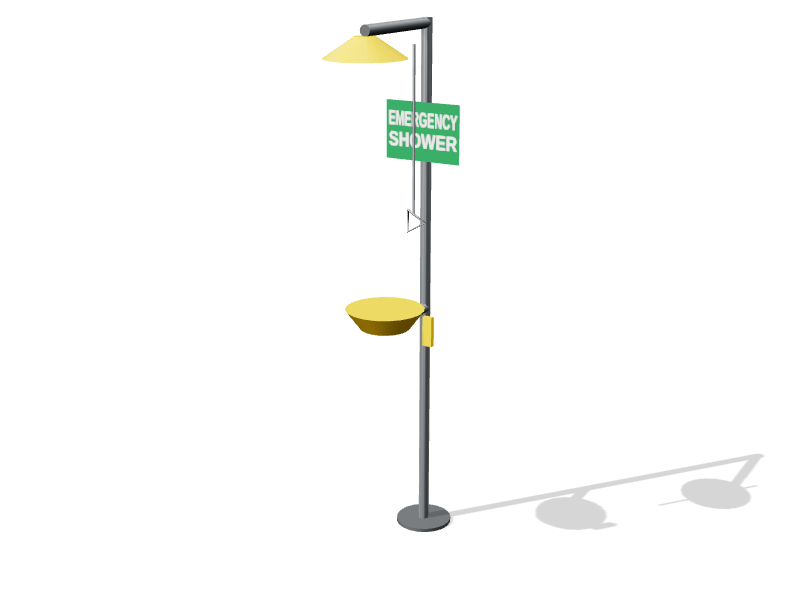
A combination unit such as our emergency shower and eyewash covers both needs in one footprint. As with any unit, ask the supplier for documentation showing how the model meets ANSI Z358.1.
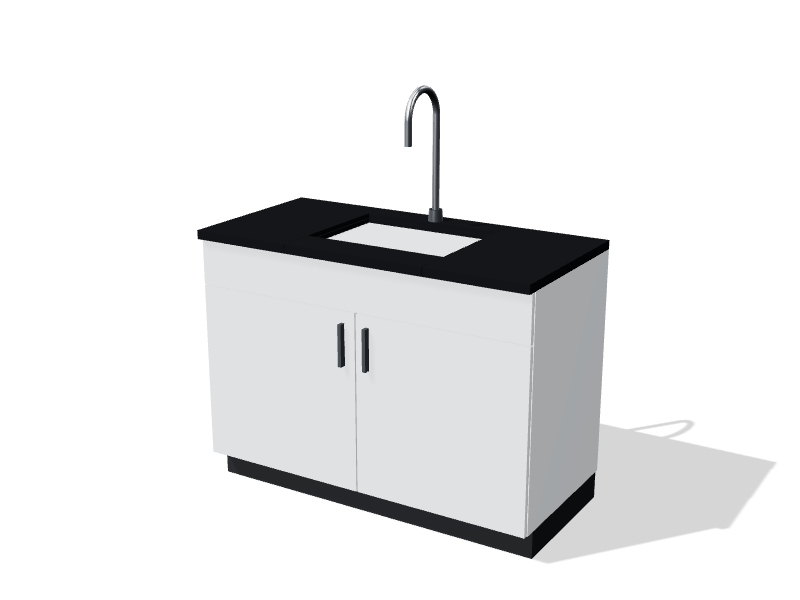
Sink-mounted and swing-down eyewashes save space at a lab sink. They must still meet the same flow, height and activation rules, and the sink must be kept clear of glassware so a person can lean straight in.
Water temperature, supply and drainage
ANSI Z358.1 calls for tepid flushing fluid, between 16 and 38 °C (60 and 100 °F). Water that is too cold makes people stop flushing early; water that is too hot can worsen some chemical injuries. Canadian municipal supplies can be well below 16 °C in winter, so most new installations use a thermostatic mixing valve fed with hot and cold water. Choose a valve designed so that cold water keeps flowing if the hot supply fails.
Plan the supply and drainage at the design stage:
- Size the pipe for the full shower flow. A shower running for 15 minutes discharges more than 1,100 L (about 300 US gal).
- ANSI Z358.1 does not require a floor drain, but the water has to go somewhere. Decide whether you need a drain, a sloped floor or a plan for clean-up, and check that nearby electrical outlets and equipment are protected.
- In labs where the run-off itself could be hazardous, such as radioisotope or high-containment work, agree with your safety officer on how it will be contained.
- Keep isolation valves accessible to maintenance staff, and prevent them from being closed casually.
Water that sits in a dead-end pipe for weeks can grow bacteria and amoebae, which is one reason regular flushing matters.
Testing and maintenance
- Activate every plumbed unit weekly to flush the line and confirm it works. Run it until clear water flows.
- Inspect every unit at least once a year against all ANSI Z358.1 requirements, including flow, temperature, height, signage and access.
- Record each test on a tag or in a log.
- Replace the fluid in self-contained eyewash units on the maker's schedule.
- Treat personal squeeze bottles and hand-held drench hoses as support for a compliant unit, not a replacement for one.
Checklist
- Map every hazard and confirm a unit within the 10-second travel distance on the same level.
- Place units near exits, clear of door swings, with signs and good lighting.
- Specify tempered water through a fail-safe mixing valve.
- Decide on drainage before the floor is finished.
- Choose barrier-free units where wheelchair users may work; see accessible lab design.
- Train every user to hold their eyelids open, flush for the full 15 minutes and remove contaminated clothing.
- Set up weekly activation and annual inspection, with records.
You can place a combination unit near the door and check clearances in the lab planner.