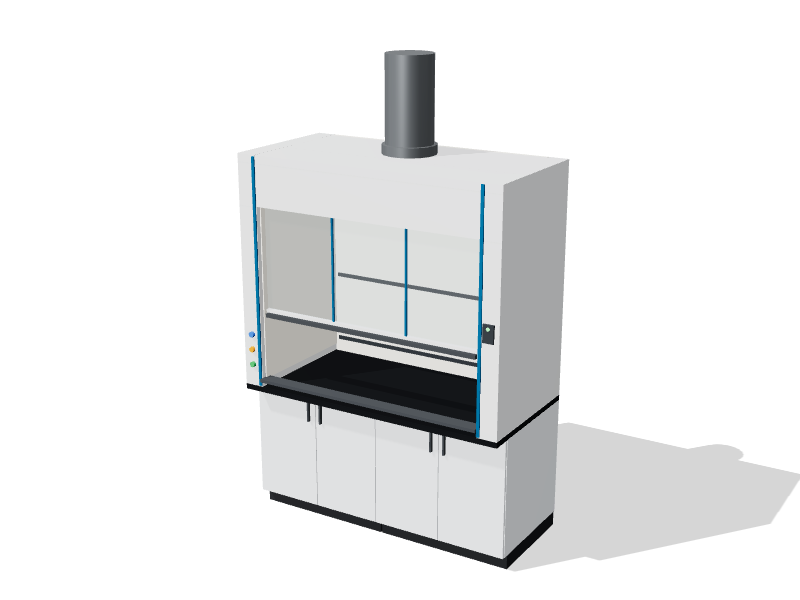
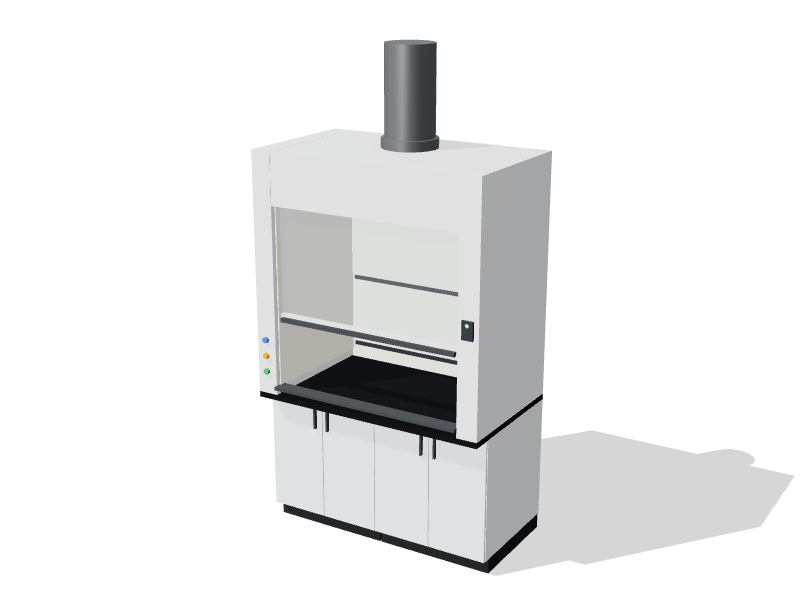
ANSI/ASHRAE 110, Method of Testing Performance of Laboratory Fume Hoods, is the most widely used way to measure how well a fume hood keeps what is released inside it from reaching the user. It is a test method, not a pass or fail standard. It explains how to test. The acceptance criteria come from your project specification, your organization's design standard, or guidance documents that reference the method.
The three core tests
The method combines three kinds of measurement. Each answers a different question.
Flow visualization
Smoke shows where the air goes. The tester releases a small stream of smoke along the work surface, around the sash edges, across the sill and along the side walls, looking for reverse flow, dead zones and any smoke escaping the face. A large-volume smoke generator then fills the hood to show how quickly and evenly it clears. Visible escape at the face is a problem whatever the other numbers say.
Face velocity
The tester measures air speed at a grid of points across the opening at the test sash height and averages them. This confirms the hood is running at the flow it is meant to be tested at and shows how even the inflow is. Face velocity explains what this number can and cannot tell you.
Tracer gas containment
This is the core of the method. A mannequin stands at the hood face with a sensitive detector in its breathing zone, about 75 mm (3 in) in front of the sash plane. An ejector inside the hood, 150 mm (6 in) behind the sash, releases a tracer gas, traditionally sulfur hexafluoride, at a fixed rate, commonly 4 L/min. Concentrations at the mannequin are logged with the ejector and mannequin at the left, centre and right of the opening. Results are reported in parts per million (ppm).
Tests often added to the core three, either from the method itself or by specification:
- Sash movement effect: the sash is raised and lowered during tracer release, to catch escapes while the airflow is disturbed.
- Edge scan: a detector probe is moved slowly around the edges of the opening to find local leaks.
- VAV response: on variable air volume hoods, how quickly and stably the flow settles after the sash moves.
AM, AI and AU
Results carry a prefix that says where and how the hood was tested, followed by the measured control level in ppm.
| Rating | Where and how tested | What it tells you |
|---|---|---|
| AM, as manufactured | Manufacturer's test room, controlled conditions | What the hood design can achieve |
| AI, as installed | In your lab, empty, after installation and air balancing | Whether the room, supply air and exhaust let the hood perform |
| AU, as used | In your lab, with the user's equipment set up | Performance under real working conditions |
A result of "AI 0.1" means the tracer level in the breathing zone during the as-installed test did not exceed 0.1 ppm at the stated release rate. Criteria often cited in North American guidance are 0.05 ppm as manufactured and 0.1 ppm as installed, at 4 L/min. Write the criteria and the release rate into your specification so there is no argument later.
An AM test proves the design can contain. Only an AI test proves the installation does. Supply diffusers, door positions and exhaust stability vary from building to building, and a hood that performed well in the factory can fail in a room with a diffuser blowing across its face.
Specifying the test
- Ask for an AM report on the exact model, width and sash configuration being supplied, at the face velocity you intend to run. This matters most for a high-performance hood, whose case rests on containing at reduced flow.
- Put AI testing in the contract, done by a qualified tester after the HVAC system has been balanced.
- State the release rate, sash heights, positions and acceptance criteria. Include the sash movement test, and VAV response for VAV hoods.
- Require the full data: smoke observations, every face velocity reading and the tracer results for each position, not only a summary page.
- Decide whether AU testing is needed for high-hazard work or after major changes to the equipment in a hood.
In Canada, CSA Z316.5 also addresses hood performance testing. Check how your organization's standard combines it with ASHRAE 110; CSA Z316.5 and fume hoods covers the background.
Reading a test report
A useful report shows:
- Hood model, size, serial number and room location.
- Sash configuration and height for each test.
- Exhaust flow and average face velocity at the time of the test.
- Room conditions: supply air running, doors open or closed, nearby equipment.
- Tracer release rate, the instrument used and its calibration date.
- Average and peak tracer readings for each position, not only an overall figure.
- Smoke observations, with any escape described and located.
- A clear statement of the criteria applied and whether each was met.
Look closely at the peaks. A hood that averages well but shows repeated spikes during sash movement, or at one position only, has a real escape path worth finding.
Checklist
- AM report matching the supplied model, size and sash
- AI test written into the contract, after air balancing
- Criteria and release rate stated in the specification
- Sash movement and VAV response tests where applicable
- Retest after relocation, major repairs or changes to supply air
- Reports kept in each hood's file alongside annual certification records