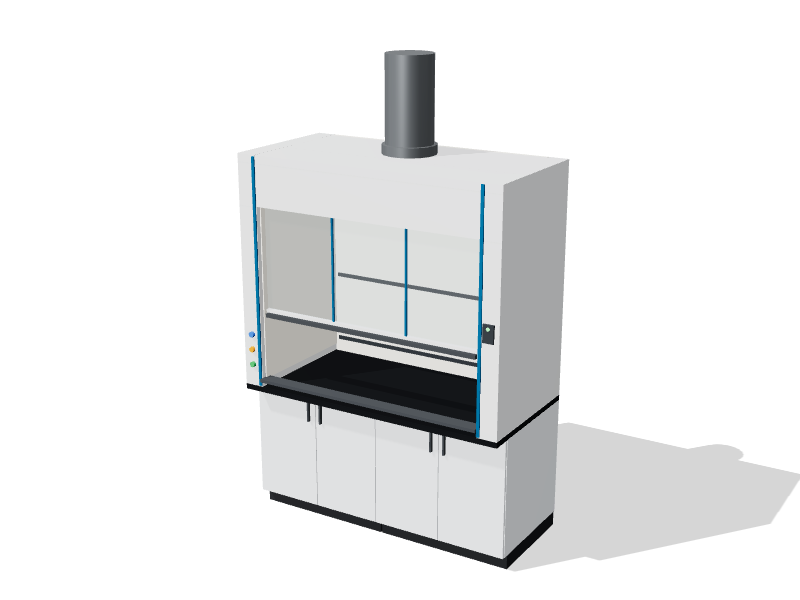
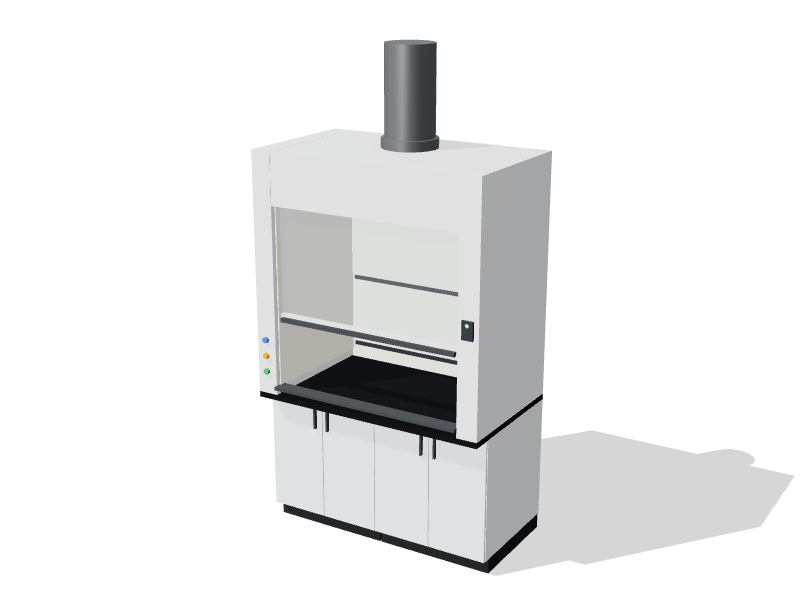
A high-performance (HP) or low-flow fume hood is designed to contain at a lower face velocity than a conventional hood, commonly around 0.3 m/s (60 fpm) instead of 0.4–0.5 m/s (80–100 fpm). Lower velocity through the same opening means less exhaust air, and less conditioned makeup air to replace it. "High performance" is not a regulated term. What earns the label is test data, not a brochure.
How they contain with less air
HP hoods rely on aerodynamics and geometry to keep the inflow smooth and stable, so less velocity is needed to resist disturbances. Common features include:
- Aerodynamic entry profiles on the side posts, sill and sash handle, which cut down eddies where air enters.
- A deeper chamber that keeps the work farther from the face.
- Refined baffles and plenum that spread suction evenly and stabilize the rolling vortex that forms behind the sash.
- Combination or horizontal sashes that shrink the working opening. The high-performance low-flow hood in our catalog uses a combination sash for this reason.
- A lower design sash height, so the full-flow opening is smaller.
None of these features alone makes a hood high performance. The combination, proven by testing, does.
Proving it
Low face velocity only works if the hood contains at that velocity. A conventional hood turned down to 0.3 m/s (60 fpm) is not a high-performance hood. It is an underventilated one.
Ask for:
- An ASHRAE 110 as-manufactured report at the face velocity you plan to run, for the exact model, width and sash type.
- Results that include sash movement tests and, on VAV systems, response tests, not only static tracer gas results.
- As-installed testing written into the contract. HP hoods have less margin against room disturbances, because the inflow they rely on is gentler.
Then check your organization's standard. Some owners require a minimum face velocity regardless of test results. If yours requires 0.5 m/s (100 fpm), an HP hood will be set to run at that velocity, and much of the reason to buy one disappears.
Where the savings are real
The savings come from moving less air every hour the hood runs at design flow. They are largest when:
- The building is constant volume. On a bypass system, an HP hood cuts exhaust around the clock. For a lab that cannot add VAV controls, this is often the most practical energy measure available.
- There are many hoods. Savings scale with total hood width.
- The climate is harsh. Heating outdoor makeup air through a Canadian winter is costly, and heat recovery from lab exhaust is not always practical.
- Exhaust capacity is the bottleneck. In a renovation, HP hoods can let you add hoods without replacing fans, ducts or air handlers. This is often the deciding factor, ahead of energy.
- Sashes stay open. Where the work keeps sashes up for long periods, VAV saves little and a lower design flow does more.
They are smaller when:
- The building has well-run VAV and users close their sashes. A closed VAV hood already runs at minimum flow, so the HP advantage applies only during open-sash hours.
- Room air changes set the supply. If the lab's minimum air change rate needs more air than the hoods exhaust, cutting hood flow does not cut supply air. General exhaust simply makes up the difference.
- The owner's standard keeps face velocity high.
How HP hoods, VAV and room air changes interact is the core of fume hood energy use. Model the options with your mechanical engineer before choosing, or ask about our engineering services.
Trade-offs
- HP hoods typically cost more than standard bypass hoods of the same width.
- They are more sensitive to supply air design and placement. A diffuser blowing across the face can undo the benefit.
- A smaller opening or a combination sash changes how users set up work. Check that tall glassware and bulky equipment still fit and can be assembled safely.
- Users need to understand the sash. Horizontal panels only save air when they are kept closed.
Checklist
- Confirm your standard permits face velocity below 0.4 m/s (80 fpm) when supported by testing.
- Get as-manufactured reports at the intended setting for the exact configuration.
- Coordinate diffuser type and location with the guidance on cross drafts and supply air.
- Compare total hood exhaust with the room's minimum air change requirement.
- Include as-installed testing and annual certification in the budget.
- Train users on the sash before the lab opens.