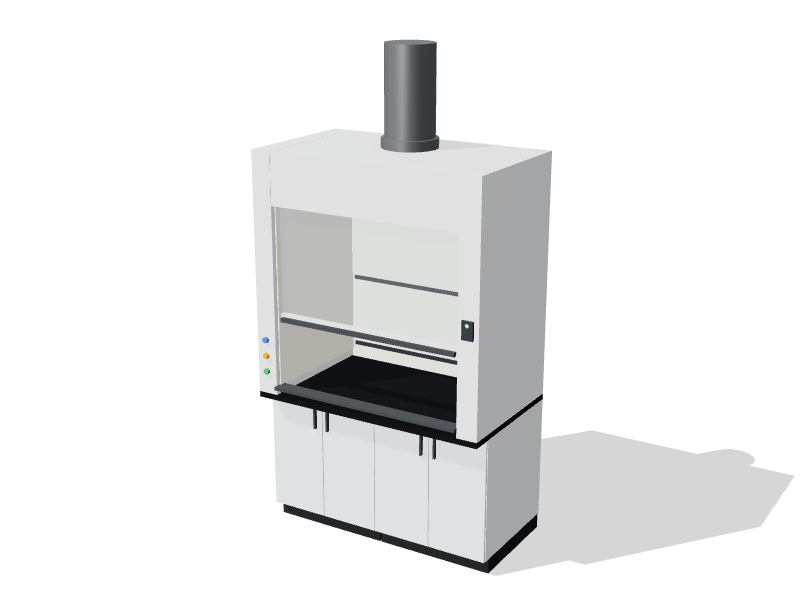
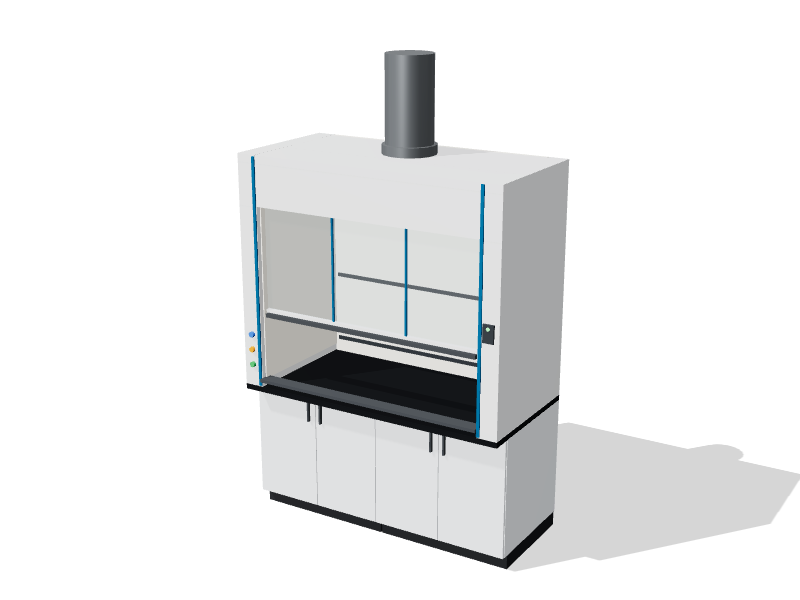
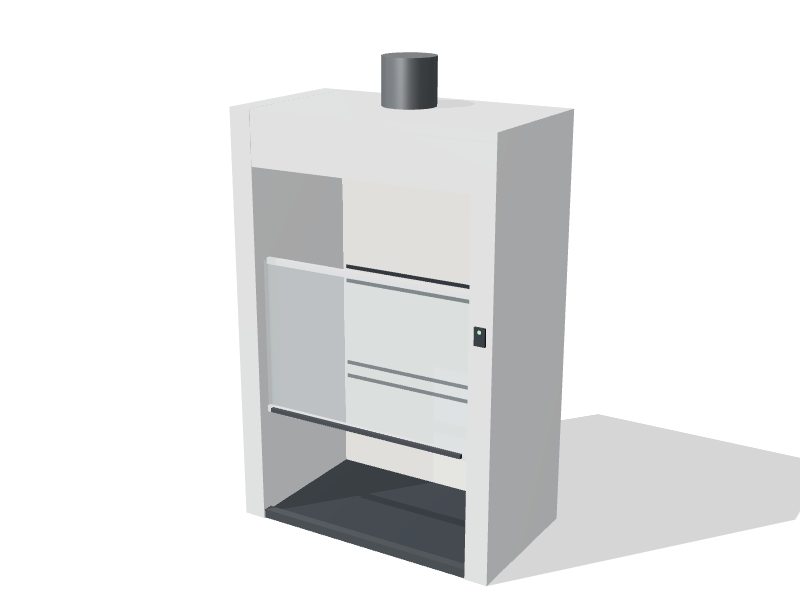
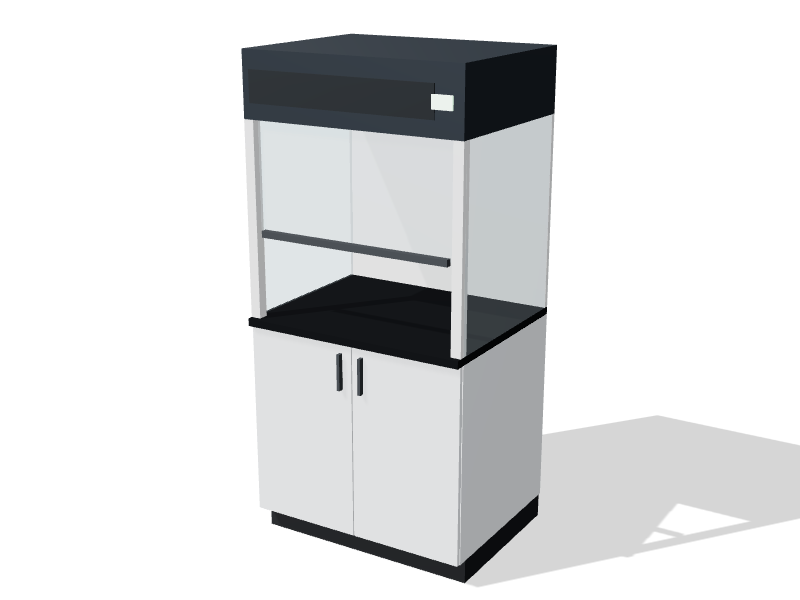
A laboratory fume hood is a ventilated enclosure that draws room air in through its front opening, past the work, and out through an exhaust duct to a fan, usually on the roof. Its job is to keep airborne contaminants released inside it (vapours, gases, fumes and fine aerosols) out of the user's breathing zone and out of the room. It does this with directional airflow, not filtration, and only within limits set by the hood, the room and the person using it.
The airflow path
Follow the air through a typical ducted benchtop hood:
- Room air enters through the face opening, the area beneath the raised sash. The average speed at which it enters is the face velocity, commonly designed around 0.4–0.5 m/s (80–100 fpm).
- Air crossing the front edge of the work surface flows over and under the airfoil sill, which sweeps the surface and prevents a rolling eddy at the leading edge.
- Inside the chamber, the air picks up contaminants released by the work and carries them toward the back.
- The rear baffles form a plenum with slots near the top, middle and bottom. The slots spread the suction over the full height and width of the chamber, so the hood draws evenly instead of mostly toward the duct connection.
- Air leaves through the duct collar on top, travels up the exhaust duct and is discharged by the fan through a stack tall enough to carry it clear of the building's air intakes.
Every cubic metre exhausted has to be replaced. Makeup air supplied to the room, heated through a Canadian winter and often cooled in summer, is the reason fume hoods are among the largest energy users in a lab building.
The main parts
- Sash: the movable glazed front. It sets the size of the opening and shields the user from splashes. Vertical, horizontal and combination designs are compared in sash types.
- Superstructure and liner: the outer cabinet and the chemically resistant inner walls. The liner material decides what chemistry and heat the hood tolerates.
- Work surface: usually a dished epoxy resin slab with a raised rim to contain spills.
- Baffles and plenum: distribute the exhaust across the chamber.
- Bypass: on constant-volume hoods, an opening above the sash that uncovers as the sash closes, so face velocity does not spike. See bypass, CAV and VAV hoods.
- Airflow monitor: a gauge or alarm that tells the user the exhaust is working.
- Service fixtures: gas, vacuum, water and electrical outlets, with valves and switches on the front posts so nobody has to reach into the hood to operate them.
- Base cabinets: storage below the work surface, with ventilated or rated cabinets where flammables or corrosives are kept.
What decides whether it contains
A hood that meets its face velocity target can still leak. Containment depends on several things at once:
- Room air movement. Supply diffusers aimed at the face, doors opening nearby and people walking past create cross drafts that can pull vapour out of the opening. A common rule of thumb keeps air movement at the face below about half the face velocity.
- Hood design. Aerodynamic sills and posts, well-set baffles and a sash with a smooth lower edge reduce turbulence where air enters.
- The user. A person standing at the face creates a low-pressure zone in front of the body. Working at least 150 mm (6 in) behind the sash plane, keeping the head outside the hood and moving slowly all help.
- What is inside. Large equipment pushed against the baffle or placed near the face blocks and distorts the airflow. Raising bulky items on blocks lets air pass beneath them.
- Heat. Hot plates and heating mantles create rising plumes that the top slot must capture.
- Exhaust stability. A slipping fan belt, a drifting damper or a leaking duct cuts the flow without anyone noticing, unless the monitor works.
This is why ASHRAE 110 testing measures leakage with tracer gas and smoke rather than relying on velocity alone.
What a fume hood is not
- Not a storage cabinet. Bottles left in the hood disturb airflow and add fuel to any fire.
- Not a biosafety cabinet. A standard ducted hood has no HEPA filtration and does nothing to protect the work from contamination. See fume hood or biosafety cabinet.
- Not a blast shield. The sash gives splash and fragment protection, but it is not rated to contain an explosion.
- Not universal. Heated perchloric acid, radioisotopes and very large apparatus each need a hood designed for the job.
Planning tips
- Choose hood types from the chemistry and the apparatus first, then decide widths and numbers.
- Keep hoods away from doors, main aisles and supply diffusers.
- Confirm early that the building can exhaust, and supply, the air the hoods need.
- Specify an airflow monitor on every hood.
- Budget for testing after installation and for annual certification.
To try hood positions against doors and aisles in your own room, use the lab planner.