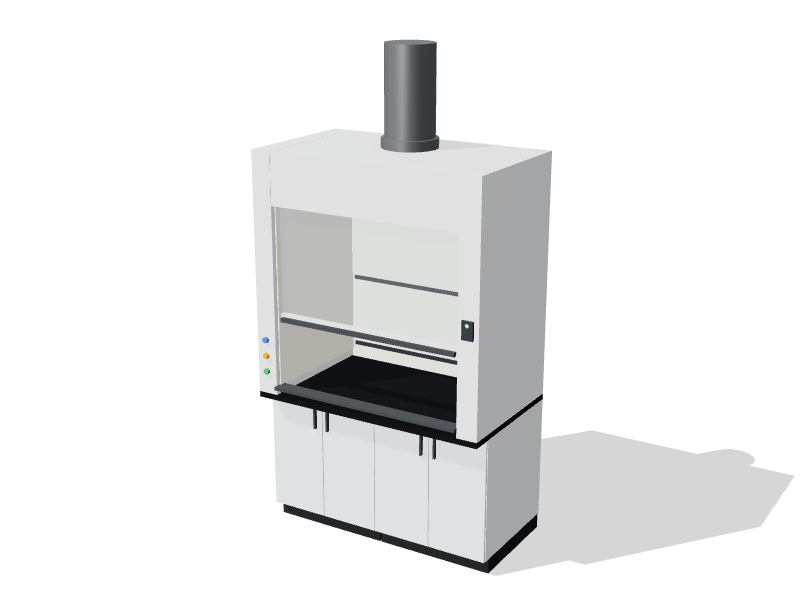
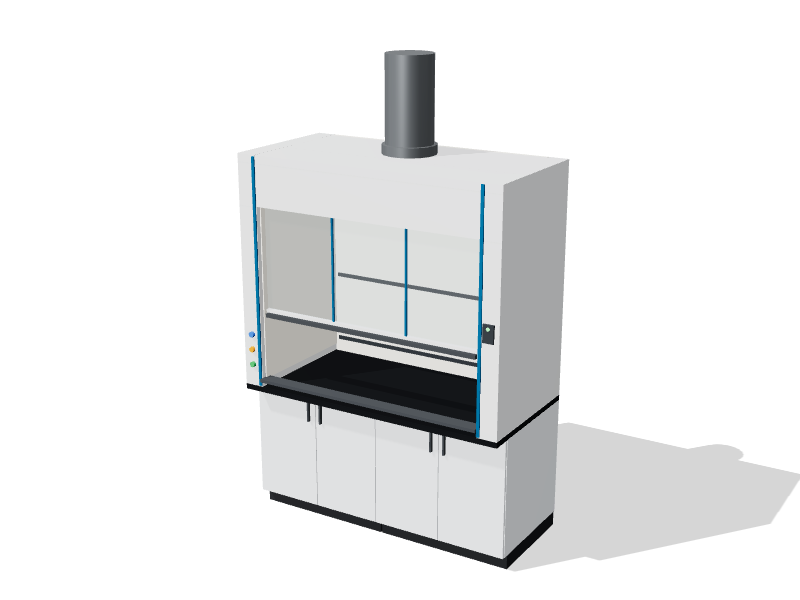
Face velocity is the average speed of air entering a fume hood through its open face: the area bounded by the sash, the side posts and the sill. It is the most quoted number in fume hood specifications and the most misunderstood. It describes how hard the hood is pulling air through its opening. It does not tell you how much of what you release inside stays inside.
How it is calculated and measured
Face velocity is the airflow through the opening divided by the open area. A hood with an opening 1.6 m wide and 0.46 m high has an open area of about 0.74 m² (8 sq ft). To reach 0.5 m/s (100 fpm), it needs roughly 0.37 m³/s (about 780 cfm) through the face, plus whatever enters through the bypass and other gaps. Halve the open area at the same flow and the face velocity doubles, which is why sash position matters so much.
Measuring it properly takes a grid. The technician divides the opening into roughly equal rectangles, holds a calibrated thermal anemometer at the centre of each one in the plane of the sash, records a time-averaged reading at each point and averages the results. ANSI/ASHRAE 110 describes this approach. A single reading in the middle of the opening, or a few seconds with a handheld vane, is not a face velocity measurement.
Two results come out of the grid:
- The average, compared with the design target.
- The spread, how far individual points stray from the average. Large differences point to baffle problems, obstructions, a damaged airfoil or room drafts. Many specifications require each reading to fall within about 20 percent of the average.
Measure at the design sash height marked on the hood, and at any other position users rely on.
Typical targets
Most organizations in North America design conventional hoods for an average of about 0.4–0.5 m/s (80–100 fpm). Some owner standards allow up to about 0.6 m/s (120 fpm). High-performance hoods commonly run lower, around 0.3 m/s (60 fpm), but only where containment testing supports that setting. The number for your building comes from the standard your organization has adopted, such as CSA Z316.5 or ANSI/AIHA Z9.5, as interpreted by your EHS office.
Faster is not safer
A higher face velocity looks like a margin of safety. Beyond a point, it works against you. Fast air flowing around a person standing at the hood forms a stronger wake in front of the body, and that low-pressure zone can draw vapour from inside the hood toward the breathing zone. High velocity also creates turbulence at the sash edge and posts, scatters powders, unsettles balances, adds noise and costs more in exhaust and makeup air. For these reasons, velocities much above 0.6 m/s (120 fpm) are generally avoided.
Too low a velocity fails differently. The inflow becomes weak compared with normal room air movement, and a door opening or a person walking past can overcome it.
What face velocity does not measure
A hood can report a perfect average and still leak. The number does not capture:
- Cross drafts from supply diffusers, doors and foot traffic. Designers commonly aim to keep room air speed near the face under half the face velocity, and lower where they can. See cross drafts and supply air.
- Turbulence and reverse flow at the sill, sash edge and posts, which only smoke visualization reveals.
- Conditions inside the hood, such as large equipment, heat sources and blocked baffle slots.
- Dynamic events: a sash raised quickly, a person walking past, or a VAV system catching up after a change.
- The user. Body position, arm movement and how far into the hood they reach all change exposure.
This is why ASHRAE 110 testing combines face velocity with smoke and tracer gas tests that measure what actually reaches a mannequin's breathing zone.
Velocity, flow and the monitor
The airflow monitor on a hood usually senses one of three things: air speed through a small port in the side wall, exhaust flow in the duct, or a pressure. Whatever it senses, it is calibrated against a grid traverse at certification. Between certifications it tells users whether flow has dropped. It cannot detect cross drafts, clutter or poor technique. If the monitor and the annual traverse disagree, recalibrate the monitor and find out why the two drifted apart.
Questions to ask
- What face velocity does our standard require, and at what sash height?
- Has this hood model been shown to contain at that velocity, both as manufactured and as installed?
- What grid and instrument were used, and how wide was the spread between readings?
- How does face velocity change across the sash travel? On a constant-volume hood without a bypass, it climbs steeply as the sash closes.
- Who recalibrates the monitors, and how often?
For testing and certification support, see fume hood certification.