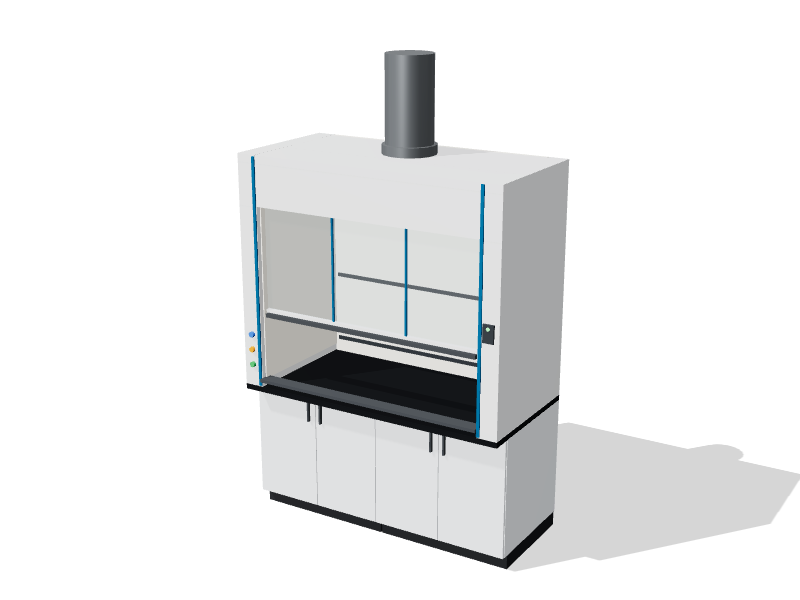
What it's for
A high-performance low-flow hood does the same job as a standard benchtop hood, but it is designed to hold containment at a lower face velocity. Lower face velocity means less exhaust air, and less conditioned makeup air to replace it. In a building with many hoods, exhaust and makeup air are among the largest energy loads, and heating that makeup air through a Canadian winter is expensive. Cutting the flow through each hood is one of the most direct ways to reduce it.
Construction and features
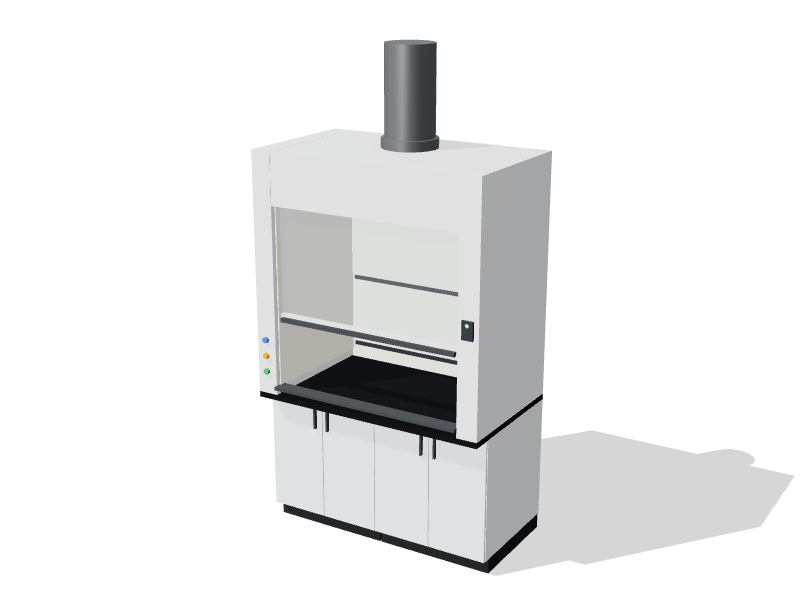
High-performance hoods rely on aerodynamics rather than raw airflow. Typical details include a shaped entry and airfoil sill, carefully set baffles and slots, and interior geometry that keeps the air pattern behind the sash stable when a person stands at the face.
This hood is designed to contain at reduced face velocity when tested to ANSI/ASHRAE 110. Ask for the as-manufactured ASHRAE 110 report at the face velocity and sash setting you intend to run, and plan for as-installed testing in your room, since room conditions affect results.
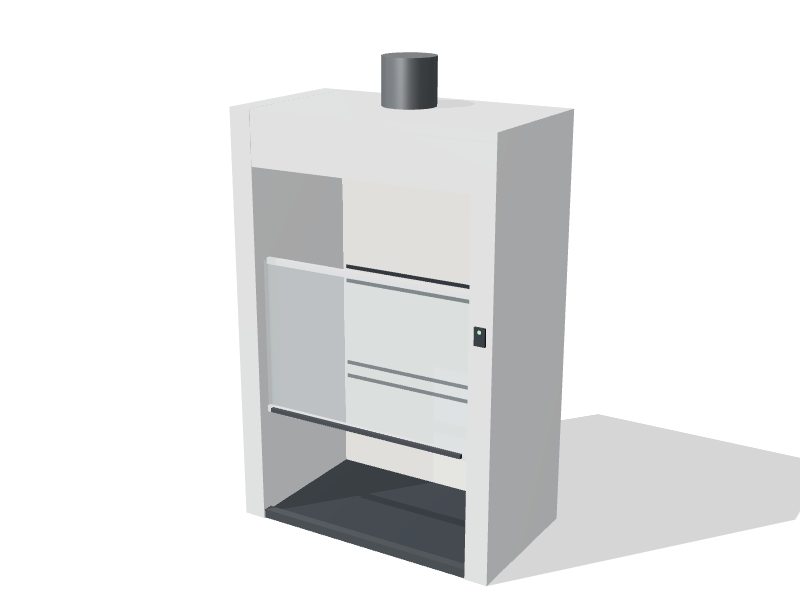
The combination sash has horizontal sliding panels set within a vertically rising frame. For most work, users reach between the horizontal panels, which keeps the open area and the exhaust volume small. The whole frame lifts when large apparatus needs to go in.
Sizes and options
Where it fits
Low-flow hoods pay off where hoods are numerous and run long hours: a research chemistry lab with a hood for each chemist, an organic synthesis lab, and a pharmaceutical QC lab with a bank of hoods for sample preparation.
Planning notes
- The savings depend on the whole system. A low-flow hood on a constant-volume exhaust saves less than one paired with VAV controls and good sash habits; see high-performance low-flow hoods.
- Agree on the operating face velocity before ordering. High-performance hoods commonly run somewhere around 0.3 to 0.4 m/s (60 to 80 fpm), but your organization's EHS policy and CSA Z316.5 set what is acceptable.
- Room air matters more at low flow. Keep supply diffusers, doors and walkways away from the face; see cross drafts and supply air.
- Train users on the combination sash. Panels left wide open undo the design.
- Fit an airflow monitor and make sure every user knows what its alarm means and what to do when it sounds.
All sizes
| Code | Width | Depth × height | From |
|---|---|---|---|
| FH-HP-1500 | 1,500 mm (59 in) | 860 × 2400 mm | $13,400 |
| FH-HP-1800 | 1,800 mm (71 in) | 860 × 2400 mm | $14,900 |