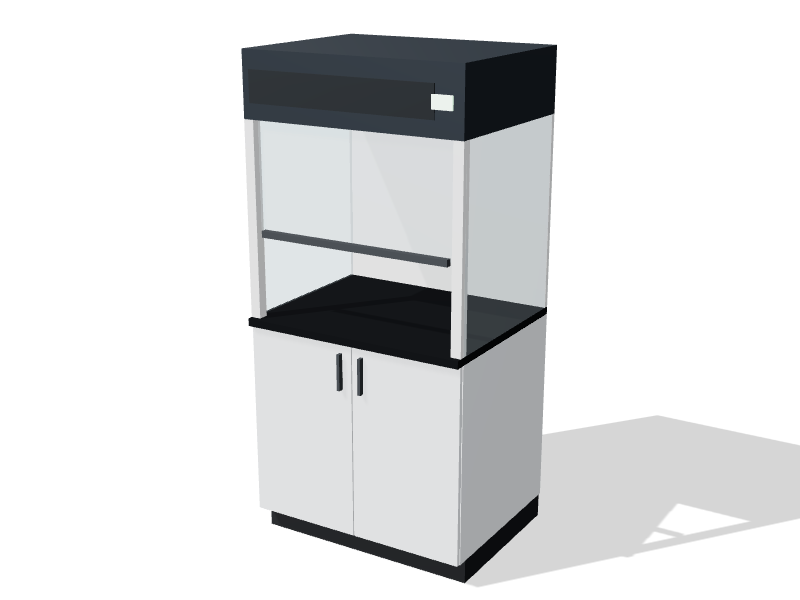
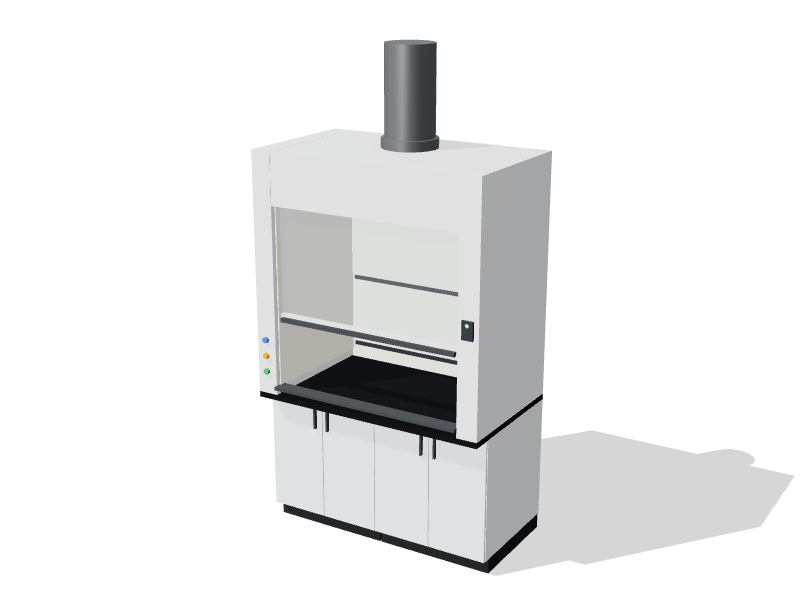
A ductless fume hood is an enclosure with its own fan and filters. It draws air in through the front opening like a ducted hood, passes it through filtration to remove contaminants, and returns the cleaned air to the room. With no ductwork, roof fan or makeup air, it can go almost anywhere with a power outlet. That convenience is real. So are the limits.
How they work
Air enters the face, usually at a face velocity similar to a ducted hood, passes through one or more filter stages above or behind the work area, and is discharged from the top of the unit into the room.
- Activated carbon adsorbs organic vapours. Its capacity is finite, and some compounds are held far better than others.
- Impregnated carbon is treated to capture specific groups that plain carbon holds poorly, such as acid gases, ammonia and amines, or formaldehyde.
- HEPA filters capture particles, for powder handling and weighing. A HEPA filter does nothing for vapours.
- Combined stacks layer carbon and HEPA for mixed work.
The filter is selected for a specific list of chemicals. That list is the heart of a ductless hood: change the chemistry and the filter may no longer capture what you release.
Where they fit and where they don't
Good applications
A ductless hood is a reasonable choice when all of these are true:
- The chemicals are known, few and stable over time.
- Quantities are small and use is intermittent.
- Each chemical is captured well by the filter media, and the supplier has confirmed this in writing.
- Toxicity is relatively low, and either the chemicals have warning properties such as odour or a sensor detects breakthrough.
- Ducting is impractical: a leased space, a temporary lab, a teaching room or a building with no spare exhaust capacity.
Typical examples include small-volume solvent work in teaching or quality control labs, slide staining stations, weighing powders under HEPA filtration, and odour control for a defined procedure.
Poor applications
Do not use a ductless hood for:
- Unknown or changing chemistry, such as research synthesis with frequently changing reagents.
- Large volumes or continuous release, such as refluxing or evaporating significant amounts of solvent. The filter saturates quickly.
- Highly toxic materials or carcinogens, or chemicals with no warning properties, where a breakthrough could go unnoticed.
- Very volatile, low molecular weight compounds that carbon holds poorly, unless a specific media is proven for them.
- Perchloric acid, radioactive materials or anything else that calls for a specialty hood.
- Reactive chemistry, or chemicals that may react on the filter media.
- Biological agents. A ductless chemical hood is not a biosafety cabinet; see fume hood or biosafety cabinet.
Filter life, monitoring and records
A ductless hood protects only as long as its filter does. As carbon nears saturation, contaminants begin to pass through, first in small amounts and then in increasing quantities, and they go straight back into the room.
A sound program includes:
- A chemical list reviewed by the supplier, with a written filter selection and an estimated filter life based on your quantities and frequency of use.
- Breakthrough detection. Many units have a sensor downstream of the main filter, or a backup filter with a sampling port between stages. Know what the sensor responds to; one designed for a class of solvents may not detect an acid gas.
- A usage log recording chemicals, quantities and time in use, so the filter life estimate can be checked against reality.
- Scheduled filter changes, with spent filters handled as hazardous waste where required.
- Airflow monitoring with an alarm for low face velocity.
- A change-control rule: no new chemical goes into the hood until the supplier and your EHS office confirm the filter handles it.
Filter replacement is a recurring cost. Include it in any comparison with a ducted hood.
Ductless and ducted compared
| Factor | Ductless filtered | Ducted |
|---|---|---|
| Installation | Power outlet only | Duct, fan and makeup air |
| Chemistry range | Narrow, defined list | Broad |
| Quantities | Small | Small to large |
| Where contaminants go | Filtered, then back into the room | Exhausted outdoors |
| Recurring costs | Filters and monitoring | Fan energy and conditioned makeup air |
| Relocation | Easy | Major work |
Questions to ask before buying
- Will the supplier review our full chemical list and quantities and state in writing which filter suits it and how long it should last?
- What breakthrough detection is included, and what can it detect?
- What face velocity does the unit run at, and how is it monitored?
- How are filters changed, and how is the technician protected during the change?
- What happens when our work changes?
- Has our EHS office approved this use?
The ductless filtered fume hood in our catalog is intended for low-volume, well-characterized chemistry where ducting is impractical. When the chemistry is uncertain, a ducted benchtop hood is the more forgiving choice.