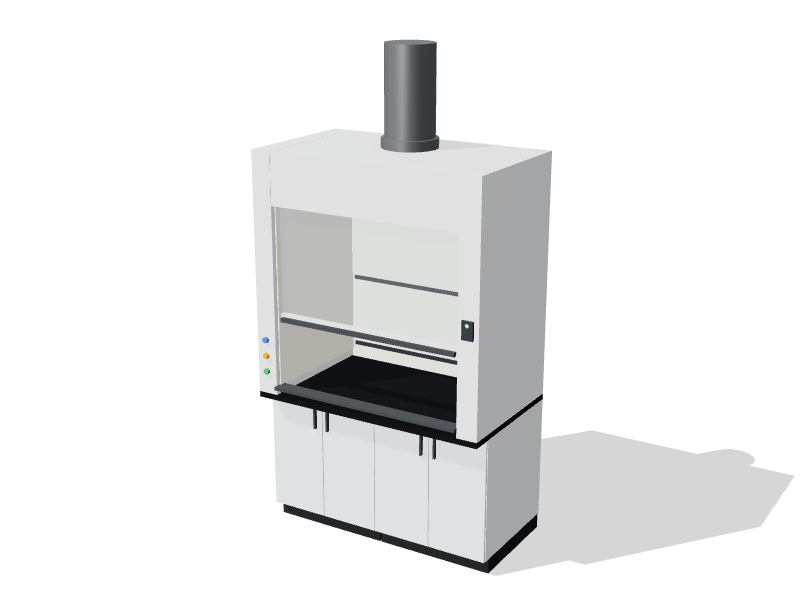
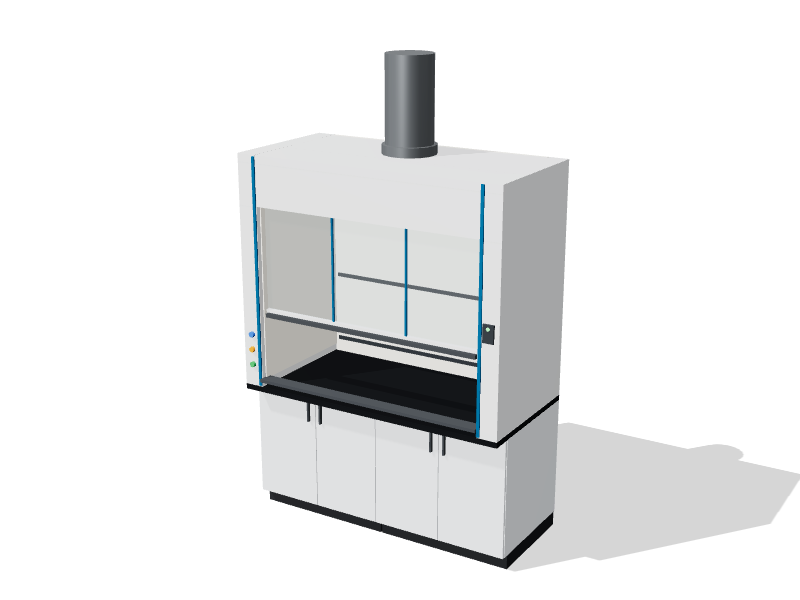
Air entering a fume hood has to turn a corner at the front edge of the work surface. If that edge is square, the air separates from the surface as it passes, forming a rolling eddy just inside the hood. That eddy can lift vapour released near the front and carry it back out of the opening. The airfoil sill is the curved bar along the front of the work surface that prevents this. It looks like a minor part. It does a lot of work.
How it works
An airfoil sill is a shaped profile, usually stainless steel or coated metal, mounted across the full width of the hood at the front edge of the work surface. It sits slightly above the surface, leaving a narrow gap beneath it, commonly around 25 mm (1 in).
Air arriving at the front of the hood splits into two streams:
- Over the top. The rounded leading edge guides air smoothly into the hood with little turbulence.
- Through the gap. Air flowing beneath the airfoil forms a thin, fast sheet that sweeps across the work surface toward the back of the hood. This keeps vapour from lingering at the front and carries heavier vapour toward the bottom baffle slot.
Most hoods also have rounded or tapered side posts that do the same job at the vertical edges of the opening.
Its other jobs
- A permanent air inlet. The sash closes onto the airfoil rather than onto the work surface, so a small opening remains even with the sash fully down. The hood keeps sweeping the work surface, and the sash is not held shut by negative pressure.
- A cord path. On many hoods, power cords and tubing can pass under the airfoil so the sash can still close. This is better than running them under a raised sash.
- A visual cue. The airfoil marks the front of the hood. Work belongs at least 150 mm (6 in) behind the sash plane, well back from it.
What happens without one
In smoke visualization, a hood without a working airfoil typically shows smoke released near the front of the work surface curling upward and toward the user, instead of travelling cleanly to the back. A damaged or blocked airfoil produces a weaker version of the same pattern. ASHRAE 110 smoke and tracer tests are designed to catch exactly this kind of escape.
Older hoods sometimes lack an airfoil, or have a flat sill with no gap. Retrofit airfoils are available for many hoods and are one of the simpler upgrades when deciding whether to retrofit an old hood. Retest the hood after fitting one.
Keeping it working
The airfoil only works if the gap stays open and the profile stays intact.
- Do not cover it. Bench liner, absorbent pads and paper towels laid along the front of the work surface often end up over or under the airfoil. Trim liners to stop short of it.
- Do not remove it. Users sometimes take an airfoil off to slide in large equipment and never refit it. If equipment cannot pass, lift it over the airfoil, or ask whether a larger hood is needed.
- Do not use it as a shelf. Bottles and tools resting on the airfoil disturb the airflow and can fall.
- Keep cords tidy. Route a few cords through the gap, not a bundle that fills it.
- Inspect it. Look for dents, corrosion, loose fixings and buildup in the gap during routine maintenance.
- Clean it with cleaners compatible with its finish, the same as the work surface.
Sash height and safe working habits covers the rest of what users can do at the face.
Airfoils on special hoods
- Walk-in hoods have no work surface, so the equivalent is a floor-level sill or threshold. Ask how the supplier manages airflow at floor level and how carts cross the threshold.
- Perchloric acid and radioisotope hoods typically use stainless airfoils with coved, seamless work surfaces, so nothing can collect in joints.
- Ductless hoods usually have an airfoil as well, and the same rules apply.
- Hoods with horizontal or combination sashes still need the airfoil; it works whichever way the sash moves.
The benchtop bypass hood in our catalog, like most current designs, comes with an airfoil sill as standard.
Checklist
- Airfoil present on every hood, full width and securely fixed
- Gap beneath it clear of liners, towels and stored items
- Cords routed neatly beneath it, not under a raised sash
- Users trained to work at least 150 mm (6 in) behind the sash plane
- Airfoil condition checked during routine maintenance and annual fume hood certification
- Hood retested after an airfoil is fitted or replaced