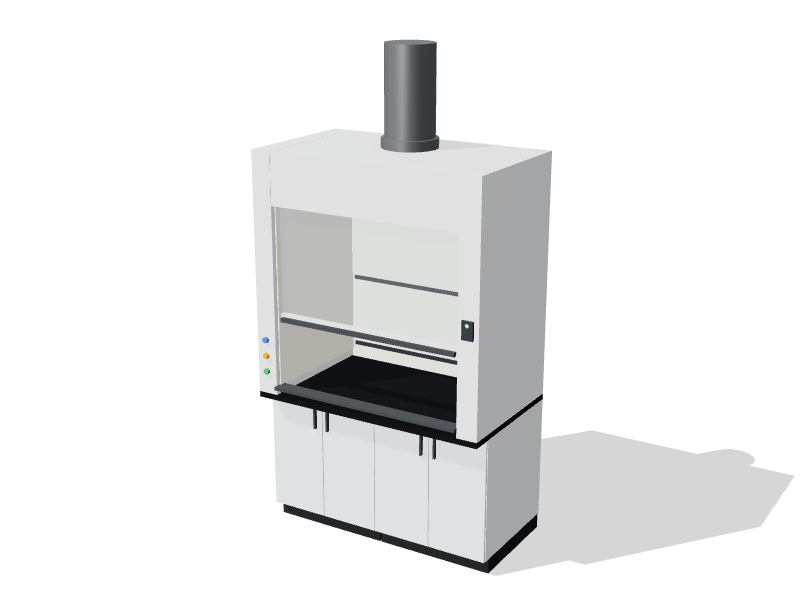
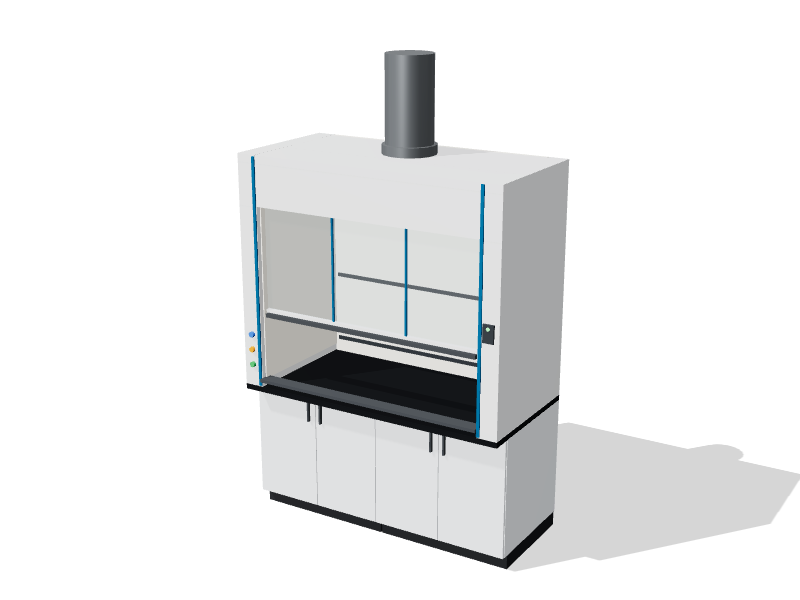
Behind the work area of a fume hood, a panel or set of panels stands a short distance in front of the back wall. These are the baffles. The space between the baffles and the back wall is the plenum, and the openings between and around the panels are the slots. Together they decide how the hood's exhaust is spread across its interior. Baffles get little attention until something goes wrong, yet they shape the airflow every user depends on.
What the baffles do
Without baffles, the exhaust connection at the top of the hood would draw most of its air from the upper part of the chamber. Air near the work surface would barely move, and the face would show high velocity at the top of the opening and low velocity at the bottom. Contaminants released at the work surface, where most work happens, would be poorly captured.
The baffle system fixes this by making air enter the plenum through defined slots, usually:
- A bottom slot at or just above the work surface, which draws air across the surface and captures vapours released low in the hood.
- A middle slot, on many designs, which evens out the flow over the height of the chamber.
- A top slot near the hood ceiling, which captures warm air and vapours rising from heat sources.
The slots are sized so the plenum acts as a pressure equalizer. Air is drawn through the full width of each slot, not just the part nearest the duct collar. The result is a reasonably uniform face velocity and a smooth sweep from the face to the back of the hood.
Fixed and adjustable baffles
Older hoods and some current models have adjustable baffles, usually a sliding panel or lever that changes the relative size of the top and bottom slots. They are often labelled for "light" and "heavy" vapours. The idea is that heavier-than-air vapours settle low and need more bottom slot, while hot or light gases rise and need more top slot.
In practice, the case for frequent adjustment is weaker than the labels suggest:
- At the dilute concentrations found in a working hood, most vapour and air mixtures have a density close to that of air. Mixing and air currents in the chamber matter more than the vapour's molecular weight.
- Heat is the stronger influence. A hot plate or heating mantle produces a rising plume, which does favour a larger top slot.
- Adjustments made by users are rarely recorded or reversed, so the hood ends up running in a setting it was never tested in.
For these reasons, many current hoods use fixed baffles set at the factory for best containment, and many labs lock adjustable baffles at the setting used during certification. If your hood has adjustable baffles, treat the setting as part of its tested configuration. Change it only for a clear reason, and retest if the change is permanent.
Common problems
- Blocked slots. Bottles, boxes or equipment pushed against the rear panel close off part of the bottom slot, and flow across the work surface becomes uneven. Keep a clear gap between equipment and the baffle.
- Missing or misplaced panels. Baffles removed for cleaning and left out, or refitted in the wrong position, change the slot geometry.
- Corrosion and residue in the plenum. Acid vapours condense on the back of the baffle and the rear wall. Residue builds up out of sight, attacks fasteners and can become a hazard in its own right. Hoods used for acid digestion need more frequent inspection.
- Paper drawn into the slots. Light items get pulled into the plenum and can lodge in the duct or a damper.
- The wrong material. Baffles should match the liner's chemical resistance. A stainless baffle in a hood used for hydrochloric acid will corrode, and a plastic baffle close to a heat source can warp. See choosing a fume hood liner.
Inspecting and cleaning
Plenum inspection belongs in routine maintenance. The person doing it should know what chemistry the hood has seen, have the hood cleared and decontaminated first, and wear suitable protection.
- Confirm with the lab that no hazardous materials are in the hood and no process is running.
- Remove the baffle panels following the manufacturer's instructions, noting their positions and any adjustment setting.
- Inspect the plenum, rear wall and duct collar for residue, corrosion, staining and loose fasteners.
- Clean with methods suited to the liner and the residue. Residue from perchloric acid or other reactive chemistry needs a specialist procedure; see perchloric acid hoods.
- Refit the baffles in their original positions and settings.
- Check face velocity and the airflow monitor afterward, and record the work.
A plenum that shows heavy deposits is a sign that the hood's use has changed or that inspection has been too infrequent. Raise it with the lab and your EHS office.
Questions to ask your supplier
- Are the baffles fixed or adjustable? If adjustable, what setting was used in the ASHRAE 110 test?
- What material are the baffles, and does it match the liner?
- Can the baffles be removed for cleaning without tools, and can they only be refitted in the correct position?
- What inspection interval do you recommend for the plenum, given our chemistry?
For a complete routine, see the fume hood maintenance checklist, or have the plenum checked as part of fume hood certification.