An analytical balance reading to 0.1 mg responds to things people barely notice: footsteps, a door closing, air from a diffuser, a hand resting on the bench. When readings drift or take too long to settle, users lose time and confidence in their results. A good weighing station combines the right location, the right table and a controlled environment. The table alone cannot fix a poor location.
What upsets a balance
The more sensitive the balance, the more carefully its surroundings need to be planned.
| Balance type | Readability | Typical setup |
|---|---|---|
| Precision (top-loading) | 1 mg and coarser | Solid bench away from drafts |
| Analytical | 0.1 mg | Balance table or very stable bench, draft shield |
| Semi-micro | 0.01 mg | Balance table in a low-traffic spot with stable temperature |
| Microbalance | 0.001 mg (1 µg) | Isolated table in a dedicated weighing area |
| Ultra-microbalance | 0.0001 mg (0.1 µg) | Dedicated room or enclosure, with specialist advice |
The usual disturbances are:
- Floor vibration from foot traffic, elevators, building fans, pumps, centrifuges and nearby roads.
- Bench vibration from people leaning on the worktop, drawers slamming and other equipment on the same top, such as stirrers and printers.
- Air movement from supply diffusers, door openings, fume hoods and people walking past.
- Temperature change from sunlight, heating cycles and nearby instruments. Temperature drift causes slow creep in readings and air currents inside the draft shield.
- Static electricity, which is common in Canadian winters when indoor air is dry. Plastic containers, filters and fine powders are the worst affected. Ionizers and anti-static weighing vessels help.
- An unlevel surface. Most balances have a level indicator, and they need to be levelled again whenever the table or balance is moved.
How a balance table works
A balance table relies on two principles: mass and separation.
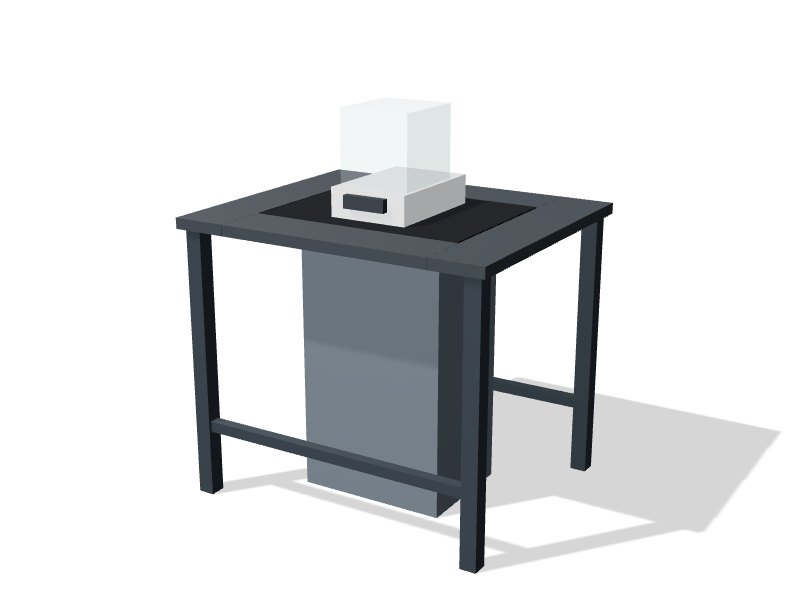
The heavy slab, usually granite, marble or a stone composite, resists being set in motion. The separation comes from carrying that slab on its own frame, with a gap between it and the surrounding worktop. When someone leans on the adjacent bench or closes a drawer, the disturbance does not travel into the slab. Our anti-vibration balance table uses a granite slab on its own steel frame for this reason. Some designs set the slab through an opening in a continuous bench so the run looks uniform while the slab stays independent.
Many tables also sit the slab on elastomer pads. Pads help, but they have limits. Every isolator has a natural frequency. Above that frequency it reduces vibration; near it, it can actually amplify vibration. A heavy slab on stiff pads handles the higher-frequency vibration from equipment and footsteps well, but it does little for slow movement of the building structure. Microbalances and ultra-microbalances in difficult locations sometimes need active isolation platforms, which sense motion and counteract it electronically.
Height and comfort matter too. Most weighing is done seated, so balance tables are commonly at seated height, around 750 to 780 mm (29½ to 30¾ in), with knee space beneath. Users should rest their forearms on the surrounding bench or an arm pad rather than on the slab itself.
Choosing the location
Location usually makes a bigger difference than the table. In order of priority:
- Floor. A ground-floor slab on grade is generally the quietest. On upper floors, positions near columns or load-bearing walls are stiffer than the middle of a floor span.
- Traffic. Keep weighing away from doors, main aisles and shared equipment that draws a queue. A bench along a wall is usually better than an island with people passing on both sides.
- Air. Keep balances away from supply diffusers, fume hoods and the room's return air path. The guide to cross drafts and supply air explains how diffuser placement affects airflow at the bench.
- Sources of vibration and heat. Keep weighing away from vacuum pumps, centrifuges, shakers, freezers and windows that get direct sun.
For new buildings and major renovations, structural engineers and vibration consultants can design floors to a vibration criterion suited to the instruments. If the lab will hold microbalances, electron microscopes or other sensitive equipment, raise this early in the layout process.
Weighing hazardous powders raises a separate problem. A fume hood's airflow makes a sensitive balance unstable, so labs handling potent or toxic powders often use a ventilated balance enclosure designed for weighing at lower, steadier airflow. Your EHS or industrial hygiene team should choose the containment level. Labs that do a great deal of weighing, such as pharmaceutical QC and analytical chemistry labs, often set aside a dedicated weighing room.
Checklist
- List every balance by readability and how often it is used.
- Choose locations before choosing tables, using the floor, traffic, air and heat criteria above.
- Size the slab for the balance, its draft shield and the user's working space.
- Confirm the slab does not touch the surrounding worktop after installation.
- Keep the slab for weighing only; put printers, stirrers and computers on the adjacent bench.
- Plan humidity control or ionizers if static is a known problem.
- After installation or any move, level the balance and have it calibrated or adjusted before use.
You can place a balance table at the quiet end of a bench run in the lab planner.