Certification proves that a cleanroom meets its class on the day it is tested. Monitoring shows that it keeps meeting it between tests. Both are needed, and both should be planned while the room is designed, because sensor locations, test ports and access for testing are far easier to build in than to add later.
A few terms get mixed up. Qualification is the formal process, often split into installation, operational and performance qualification, that shows a new room was built and works as specified. Classification is the particle test under ISO 14644-1 that assigns an ISO class. Requalification repeats the key tests at set intervals. Monitoring is the routine measurement that runs continuously or on a schedule in between.
What a certification visit covers
Most certification work follows the test methods in ISO 14644-3, plus anything your regulator or customer adds.
| Test | What it shows |
|---|---|
| Airflow velocity and volume | Each filter and room delivers its design airflow and air change rate |
| Installed filter leak test | No leaks through HEPA filter media, gaskets or frames, found by aerosol challenge and scanning |
| Pressure differentials | Each room holds its place in the cascade |
| Particle counts | The room meets its ISO class in the stated occupancy state |
| Airflow visualization | Smoke studies show air moving away from critical work, especially in unidirectional zones |
| Recovery | How quickly the room returns to its class after a particle challenge |
| Temperature and humidity | Conditions sit within the design range |
Particle counts are the headline result, but filter leak testing and pressure checks catch more of the problems that develop over time. In sterile compounding, certification also covers the primary engineering controls, such as clean benches and biosafety cabinets, and USP <797> adds viable air and surface sampling on its own schedule.
How often rooms are tested
The interval depends on the standard you work to:
- ISO 14644-2 sets maximum intervals for showing continued compliance, shorter for ISO 5 and cleaner than for other classes. It lets a documented monitoring plan support the chosen interval.
- GMP Annex 1 expects grade A and B areas to be requalified at least every six months and grade C and D areas at least every twelve months. See GMP grades A to D.
- USP <797> requires certification of compounding rooms and primary engineering controls at least every six months, and after relocation or major changes. The compounding cleanroom guide covers the wider requirements.
Retest outside the schedule after any change that could affect performance: filter replacement, new penetrations, HVAC repairs, layout changes, or a run of monitoring excursions.
Routine monitoring between certifications
A monitoring plan defines what is measured, where, how often, and what happens when a result is out of range. ISO 14644-2 asks for it to be based on risk, and Annex 1 expects it to form part of the contamination control strategy.
- Continuous. Room pressure differentials, temperature and humidity are usually monitored continuously with local displays and central alarms. In GMP grade A zones, particles are monitored continuously during critical processing.
- Scheduled. Particle counts at fixed locations, plus viable monitoring in pharmaceutical and compounding rooms: active air sampling, settle plates, contact plates on surfaces and, in GMP, glove prints.
- Alert and action levels. An alert level warns of a drift before it becomes a failure. An action level triggers an investigation and corrective action. Set alert levels from your own historical data, below the regulatory limits.
- Trending. Single results matter less than patterns. Review data monthly at minimum, look for creeping counts near doors or at shift changes, and link excursions to events such as maintenance or new staff.
- Data integrity. Monitoring systems in regulated rooms need secure records, audit trails and time synchronization.
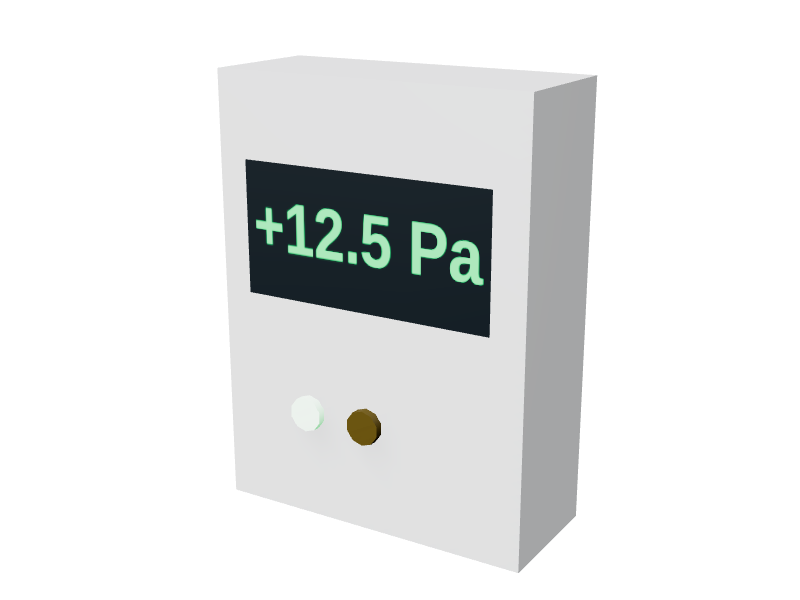
Plan sensor locations on the drawings. Pressure sensors belong in each critical room with a reference in the corridor. A wall-mounted room pressure monitor at each door gives staff an immediate check before they enter.
Choosing a certifier
- Ask which standards and guidance documents the technicians test to, and for sample reports from similar rooms. In compounding, many certifiers follow the application guides published by the Controlled Environment Testing Association.
- Confirm that particle counters, photometers and anemometers are calibrated with traceable certificates, and that the report lists instrument serial numbers and calibration dates.
- Expect the report to show as-found and as-left results, a map of sample locations, the occupancy state, deviations, and any repairs made during the visit.
- Agree in advance who corrects failures, such as filter repairs or rebalancing, and how retests are scheduled.
Planning checklist
- Write the classification target, occupancy state and particle sizes into the design brief.
- Specify filter test ports and access for scanning every installed filter.
- Show monitoring sensor locations and alarm routes on the drawings.
- Set requalification intervals and book the first recertification before handover.
- Define alert and action levels and who responds to each alarm.
For a refresher on what the classes mean, see ISO 14644-1 cleanroom classes.