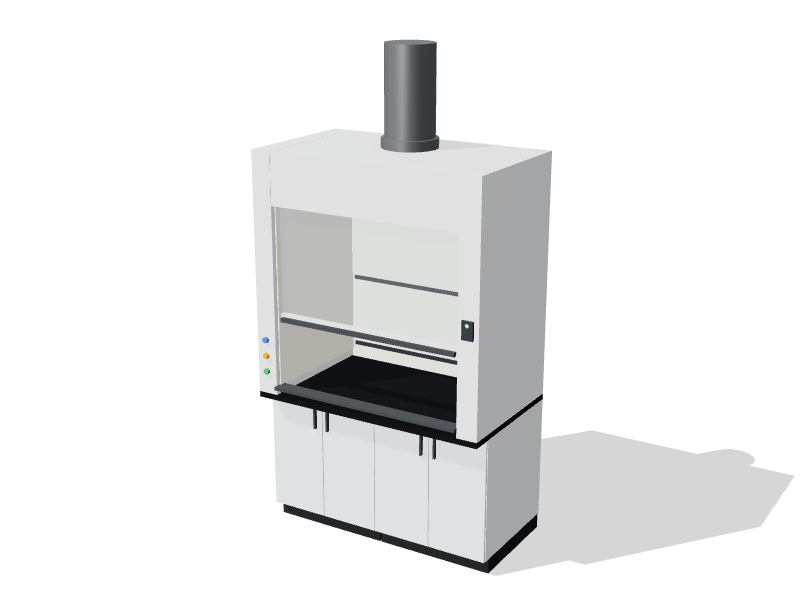
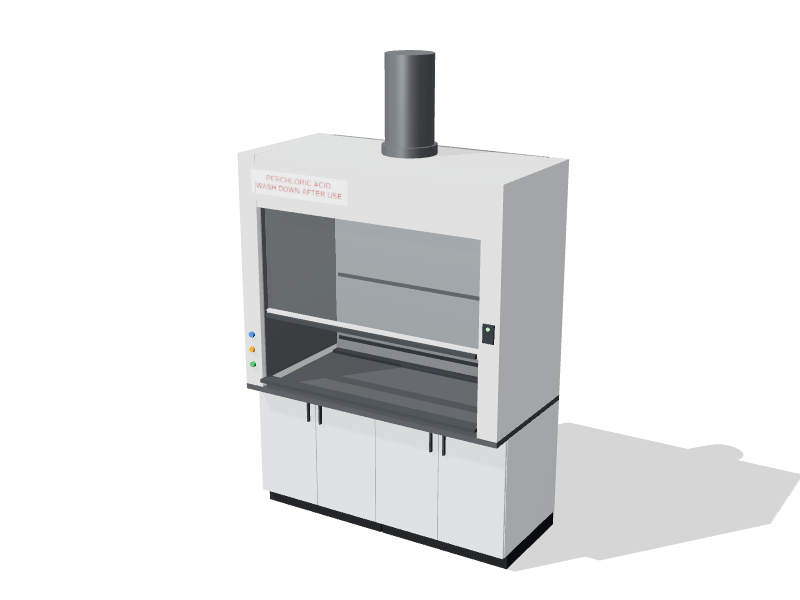
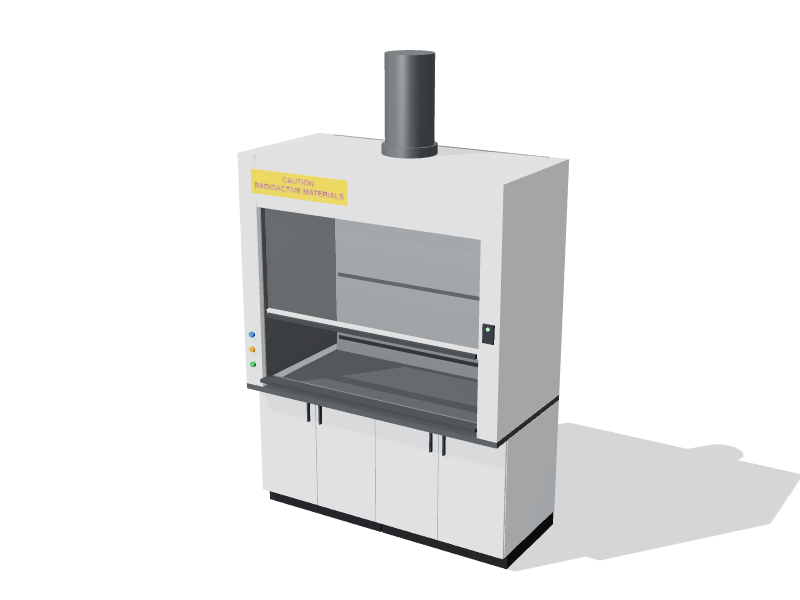
A fume hood is only the inlet of a system. The duct, the fan and the stack on the roof do the actual work of moving contaminated air out of the building and dispersing it where nobody breathes it again. Many hood problems blamed on the hood start in this system: a slipping fan belt, a corroded duct, a stack that sends exhaust straight back into an air intake. This guide covers the main design choices so lab managers and architects can ask the right questions of the mechanical engineer.
Ducts: material, route and pressure
Duct material follows the chemistry. The table below shows the common options.
| Material | Suits | Watch for |
|---|---|---|
| Galvanized steel | Dry, mildly contaminated exhaust | Corrodes quickly with acid vapours and condensate |
| Stainless steel (304 or 316) | Broad chemical use; welded 316 for perchloric acid systems | Higher cost; chlorides attack 304 |
| Coated steel (PVC or fluoropolymer) | General chemistry with acids | Coating damage at joints and cut edges |
| Plastics and fibreglass-reinforced plastic | Strong acids and digestion work | Combustible, so fire codes restrict where they can go |
Fire codes and NFPA 45 restrict combustible duct materials. Where plastic or fibreglass duct is used, it typically needs a low flame-spread rating, sprinkler protection or a rated shaft, depending on the code path the engineer of record takes.
A few routing principles apply to almost every system:
- Keep ducts under negative pressure inside the building. Locate the fan at the end of the run, usually on the roof. Any leak in the duct then draws room air in instead of pushing exhaust out into a ceiling space or shaft.
- Seal or weld joints. Lab exhaust carries corrosive and sometimes toxic vapours. Sealed joints keep condensate in and leaks small.
- Avoid low points. Slope horizontal runs so condensate drains back toward the hood or to a proper drain, rather than pooling and corroding the duct.
- Keep velocity moderate. Lab exhaust ducts commonly run at about 5 to 10 m/s (1000 to 2000 fpm). That is fast enough to carry vapour and light particles, and slow enough to limit noise and pressure loss.
- No automatic fire dampers. NFPA 45 generally does not allow automatic fire dampers in hood exhaust ducts, because a closed damper would shut the hood down during a fire. Ducts pass through fire-rated shafts instead.
Fans: dedicated or manifolded
There are two basic arrangements.
Dedicated fans give each hood its own duct and fan. The system is simple and independent: a fan failure affects one hood, and incompatible exhaust streams never meet. The cost is many roof penetrations, many fans to maintain and little flexibility. Perchloric acid hoods always need a dedicated system with washdown, and radioisotope hoods often get one so filters and monitoring can serve that hood alone.
Manifolded systems connect many hoods to a common header served by a group of fans, often with one spare fan so the system keeps running when one is down for service. Manifolds work well with VAV hoods because not every sash is open at once, so the fans can be sized with a diversity factor. They also make energy recovery easier. The header must be held at a steady negative pressure, and the engineer must confirm that exhaust streams mixing in the duct are compatible.
Whatever the arrangement, fan construction should match the exhaust:
- Coated or stainless wheels and housings for corrosive exhaust.
- Spark-resistant construction where flammable vapours may be present.
- Motors and belts outside the airstream, with safe access for inspection.
- Vibration isolation and flexible connections, which also cut noise (see fume hood noise).
- Standby power where the risk assessment calls for exhaust during a power failure.
Stacks and discharge
The stack's job is to throw exhaust high enough and fast enough that the plume clears the building and does not wrap back into air intakes, operable windows or a neighbouring building. ANSI/AIHA Z9.5 calls for stacks at least 3 m (10 ft) above the adjacent roof line and discharge velocities of about 15 m/s (3000 fpm) or more. Other good practice includes:
- Discharging straight up. Rain caps that deflect the plume downward defeat the purpose; use stack designs that drain water without blocking upward flow.
- Keeping stacks well away from air intakes, and studying dispersion with a wind or modelling study where the roof is crowded or taller buildings stand nearby.
- Holding stack velocity steady when VAV hoods turn down. Manifolded systems commonly add outdoor bypass air at the fan, or use high-plume fans that entrain outdoor air to lift the plume.
Roof workers need protecting too. Mark the exhaust stack zone, and have a procedure for shutting down fans or using respiratory protection before anyone works close to a discharge.
Questions to ask your engineer
- Dedicated or manifolded, and why for this lab?
- Which duct material, and how does it meet the fire code?
- Where is the fan, and is every duct inside the building under negative pressure?
- How is fan redundancy handled, and which fans are on standby power?
- What stack height and discharge velocity are proposed, and has re-entrainment been checked?
- How will facilities staff reach fans, belts and duct access doors safely?
- How will the exhaust volume at each hood be verified at commissioning?
For a new building or a major renovation, our engineering service can review exhaust design alongside the hood selection.