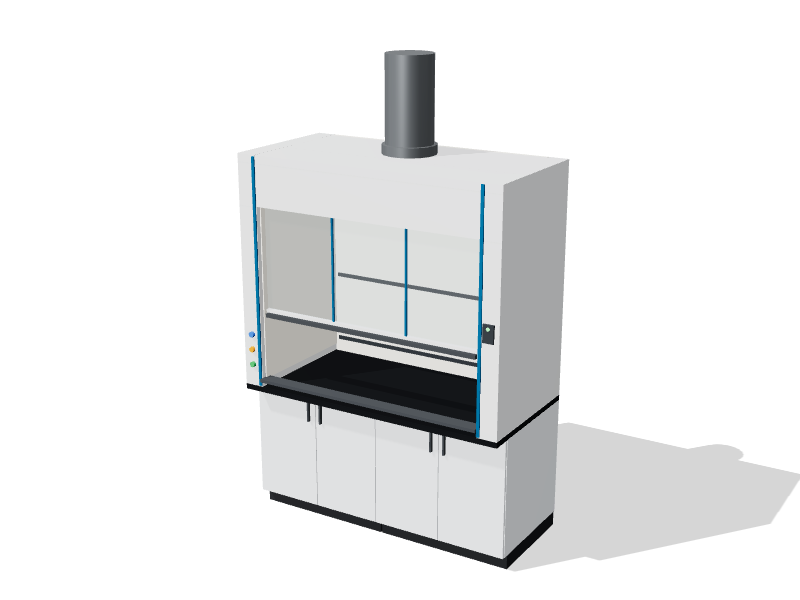
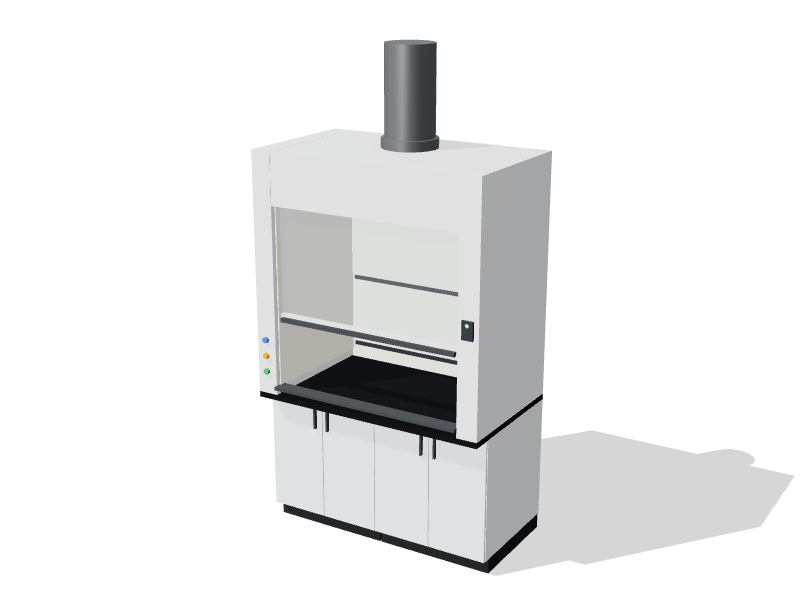
A fume hood itself draws very little power: a light, perhaps a monitor and a VAV valve actuator. The energy goes into the air. Every litre a hood exhausts is outdoor air that the building had to filter, heat or cool, humidify or dehumidify, and push through the supply and exhaust fans, and none of it is recirculated. In a Canadian winter, that means heating outdoor air from well below freezing to room temperature around the clock. In labs with many hoods, ventilation is often the largest energy load in the building.
Where the energy goes
Hood exhaust volume is simply the open area of the sash multiplied by the face velocity. A worked example shows why sash height matters so much.
- A hood with a 1500 mm (59 in) wide opening and the sash fully raised to 700 mm (27½ in) has an open area of 1.05 m². At 0.5 m/s (100 fpm) it exhausts about 525 L/s (about 1110 cfm).
- Lower the same sash to 460 mm (18 in) and the open area drops to 0.69 m². At the same face velocity the hood needs about 345 L/s (about 730 cfm).
- Close the sash on a VAV hood and the exhaust falls to the minimum flow the engineer set to keep the hood interior diluted.
How much of that saving you actually get depends on the hood's control type.
| Hood control | What sets the exhaust | Main saving lever |
|---|---|---|
| Bypass, constant volume | Fixed at the design volume, sash open or closed | Design for a restricted sash height; remove unneeded hoods |
| Two-state constant volume | A high and a low setting, switched by schedule or occupancy | Use the low setting when the lab is unoccupied, if EHS approves |
| Variable air volume (VAV) | Sash opening multiplied by the target face velocity, above a set minimum | Close sashes whenever the hood is not in active use |
| High-performance low-flow | Lower design face velocity, verified by containment testing | Less air at the same opening; still benefits from VAV |
A bypass hood sized for a full-height sash exhausts its full design volume 24 hours a day. That is why many constant-volume hoods are designed and certified for a restricted working height with a sash stop, which caps the design volume. The guide to bypass, CAV and VAV hoods explains the control types in more detail.
Ways to cut hood energy
Close the sash
On a VAV hood, closing the sash is the single biggest saving available, and it improves safety at the same time. Sash campaigns, reminder labels and monthly reports by lab all help. Automatic sash closers with presence sensors close the sash when nobody is at the hood; check that they stop safely against apparatus and that users know how to override them.
Choose low-flow hoods where they fit
A high-performance low-flow hood is designed to contain at a reduced face velocity when tested to ASHRAE 110. It needs a calm room with low cross drafts, and the reduced velocity must be accepted by your EHS office.
Match the number of hoods to the work
An idle hood still exhausts air. Hoods that nobody uses should be properly decommissioned: emptied, cleaned, disconnected and capped, with the room rebalanced. Leaving a hood running "just in case" is expensive insurance.
Recover heat from the exhaust
Lab exhaust can carry contaminants, so recovery systems that keep the exhaust and supply airstreams completely separate, such as run-around glycol loops and some heat pipe arrangements, are common choices. Devices that allow some leakage between streams need careful evaluation by the engineer.
Tune the exhaust fans
Manifolded systems often hold stack discharge velocity constant by bringing in outdoor bypass air at the fan. Controls that reduce fan volume when wind and dispersion conditions allow can cut fan energy without compromising the plume. See exhaust ducts, fans and stacks.
Review room air change rates
When hoods are closed, the room's minimum air changes per hour may set the airflow instead. Some labs lower that minimum during unoccupied hours or use air-quality sensing to adjust it, with EHS agreement.
What not to do
- Do not lower face velocity below the value the hood was tested and certified for.
- Do not shut hoods off overnight if chemicals are stored in them or reactions are running.
- Do not block the bypass grille on a constant-volume hood to save air without converting the controls. Face velocity at low sash heights shoots up, turbulence increases and the room balance changes. Converting properly is covered in retrofit or replace an old fume hood.
- Do not let an energy measure disable or delay the airflow alarm.
Planning tips
- Ask each hood supplier for the exhaust volume at your intended working sash height, not just at full open.
- Have the mechanical engineer estimate annual energy using local climate data, comparing at least two hood and control options.
- Plan the VAV system with a realistic diversity factor for how many sashes will be open at once.
- Involve EHS early in any setback, low-flow or sash-closer decision.
- Check whether your utility offers incentives for ventilation efficiency projects before you finalize the design.
A consultation can compare hood options for your room, chemistry and climate before you commit to a ventilation design.