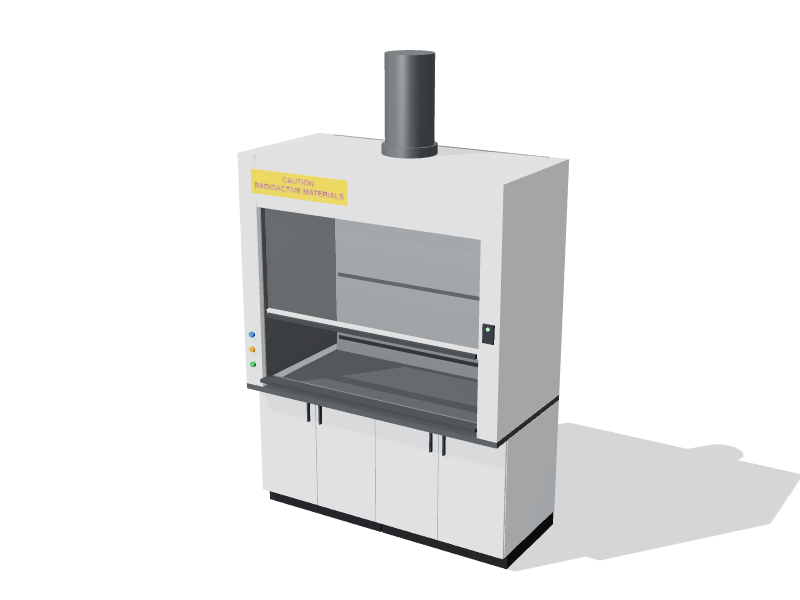
A radioisotope fume hood is built for work with unsealed radioactive materials that could become airborne, such as volatile radioiodine compounds or radiolabelled reagents being heated, evaporated or opened. Its airflow works like any ducted hood. What sets it apart is how it handles contamination, shielding and exhaust.
How the hood is built
Every feature serves one goal: making contamination easy to find and remove.
- Seamless stainless steel liner. Welded, with coved internal corners and no exposed fasteners, so there are no joints or crevices for contamination to lodge in. Stainless steel also stands up to repeated scrubbing and decontamination agents that other liners may not.
- Integral stainless work surface. A dished, coved work surface with a raised rim contains spills and can be wiped and surveyed easily.
- Reinforced for shielding. Lead bricks and shielding are heavy. The work surface and the base cabinet beneath it must be rated for the load. Get the rated load in writing and check it against your shielding plan.
- Accessible baffles and plenum for wipe testing and cleaning.
- Smooth, cleanable exterior surfaces that can be surveyed quickly.
Liner choices for other hood types are covered in choosing a fume hood liner. For radioisotope work, stainless steel is the usual answer.
Exhaust and filtration
Whether the exhaust needs filtration depends on the nuclides, the quantities and the licence conditions.
- No filtration: many labs working with small quantities discharge through standard exhaust to a stack, with releases kept within licensed limits.
- HEPA filtration: where work could release radioactive particulates.
- Activated carbon: for volatile radioiodine and some other gases, usually in a dedicated filter housing.
- Bag-in/bag-out housings: let technicians change filters without direct contact and without spreading contamination.
Filter housings need safe access, test ports so filter performance can be checked in place, and a plan for surveying and disposing of spent filters. For higher-activity work, a dedicated duct and fan is often preferred over a shared exhaust system, so contamination stays confined and the duct can be monitored. Some licences also call for monitoring of the exhaust stack. See exhaust ducts, fans and stacks for general exhaust design.
The Canadian regulatory picture
In Canada, the Canadian Nuclear Safety Commission (CNSC) licenses the use of nuclear substances. Rooms where unsealed nuclear substances are used are classified, commonly as basic, intermediate, high or containment level, according to the quantities handled. The classification drives expectations for the room's finishes, ventilation and fume hoods. The CNSC publishes design guidance for nuclear substance laboratories, and at the higher classifications the licensee generally submits design information for review before construction.
What this means for hood planning:
- Involve the Radiation Safety Officer (RSO) from the start. The RSO knows the licence conditions, nuclides and quantities, and what the CNSC will expect to see.
- Confirm the room classification before selecting the hood, exhaust and filtration.
- Plan for decommissioning on day one. Surfaces, ducts and filters will eventually need to be surveyed and released, and seamless stainless makes that far easier.
The licensee's RSO and the CNSC have the final say on hood requirements for licensed work.
Work that combines radioisotopes with biological material, such as radiolabelling in cell culture, may need a biosafety cabinet instead of a fume hood, or both. See fume hood or biosafety cabinet.
Layout and daily use
- Place the hood within the designated area, away from doors and traffic, with room nearby for shielding storage, a survey meter, waste containers and a sink for decontamination. The radioisotope lab page covers the room as a whole.
- Keep surrounding surfaces cleanable. Smooth, non-absorbent casework and worktops, such as stainless steel, and sealed floors with integral coving make surveys and cleanup straightforward.
- Use spill trays and absorbent liners inside the hood, kept clear of the baffle slots and the airfoil.
- Label the hood with the radiation warning symbol and the nuclides in use, as the licence requires.
- Survey routinely, with wipe tests of the work surface, sash and exterior on the schedule set by the radiation safety program.
- Keep the chemistry compatible. Do not use a radioisotope hood for perchloric acid digestions unless it was designed for that work as well.
Questions to ask your supplier
- What is the liner grade and finish, and are all seams welded and coved?
- What is the rated load of the work surface and the base cabinet?
- Can the hood take HEPA or carbon filtration, or a bag-in/bag-out housing, now or later?
- Which decontamination agents are compatible with the surfaces?
- Can you provide an ASHRAE 110 as-manufactured test report for this model?
The radioisotope fume hood in our catalog has a seamless stainless liner and a coved stainless work surface reinforced to carry lead shielding.