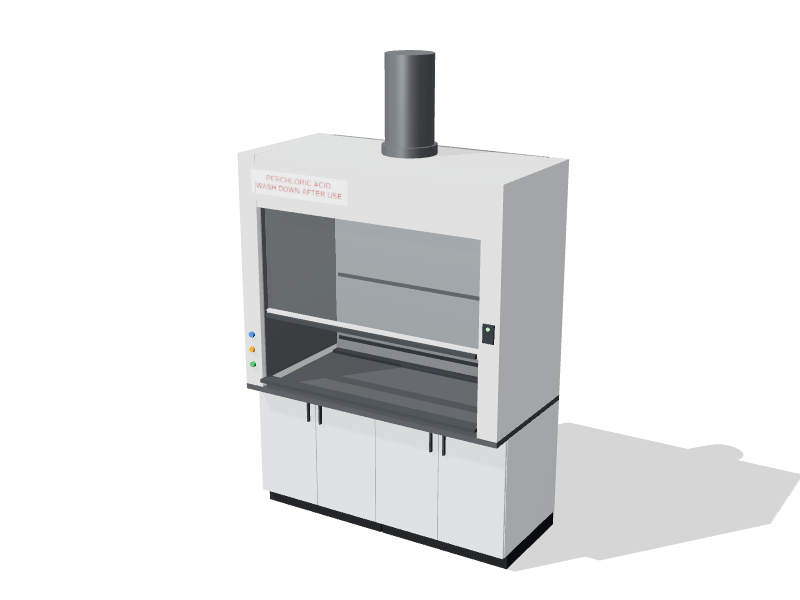
Perchloric acid is a strong acid and, when hot and concentrated, a powerful oxidizer. It is widely used for wet digestion of samples in analytical, geochemical, environmental and food labs. The problem for hood design starts after the vapour leaves the beaker. Heated perchloric acid gives off vapours that can condense in the hood, the duct and the fan, leaving perchlorate residues. Those residues can be shock-sensitive and can react violently with organic materials. An ordinary fume hood has no way to prevent or remove them.
What makes a perchloric acid hood different
A perchloric acid hood is built so residues have nowhere to accumulate, and so any that do form can be washed away.
- Seamless, non-reactive liner. Typically welded stainless steel, often type 316, with coved internal corners. Nothing organic, such as sealants, gaskets or coatings, is exposed to the airstream.
- Integral washdown. Spray nozzles behind the baffle and in the duct rinse the plenum, the back of the baffle and the duct interior with water.
- Drain trough. A trough at the back of the work surface collects washdown water and carries it to a drain.
- Coved work surface. An integral, dished surface that contains spills and can be washed clean, with no joints for residue to collect in.
- Accessible baffles so the plenum can be inspected.
- Clear labelling identifying the hood as reserved for perchloric acid work.
Exhaust: duct and fan
The duct and fan matter as much as the hood, because that is where residues build up out of sight.
- Dedicated exhaust. Each perchloric acid hood normally has its own duct and fan, not shared with other hoods or general exhaust, where organic vapours could meet perchlorate residues.
- Straight vertical runs. The duct runs as directly as possible to the roof, avoiding horizontal sections and sharp bends where condensate and residue settle.
- Suitable duct material. Typically welded stainless steel, smooth inside, with no organic sealants at the joints.
- Washdown along the duct, with access points for inspection.
- A fan selected for the service, built from corrosion-resistant materials and arranged so no organic lubricant or component is exposed to the airstream, often with its own wash nozzles.
- Discharge through a vertical stack well clear of air intakes.
NFPA 45 includes specific provisions for perchloric acid hoods and their exhaust, and many owner standards add requirements of their own. Exhaust ducts, fans and stacks covers general exhaust design.
Operating the hood
Washdown routine
The washdown only protects you if it is used.
- Run the washdown after each use that involves heating perchloric acid, or on the schedule your procedures set.
- Let it run long enough to rinse the plenum and duct thoroughly, following the manufacturer's guidance.
- Confirm water is draining from the trough rather than pooling.
- Record each washdown in a log kept at the hood.
- Inspect the plenum and accessible duct sections at the intervals in your maintenance plan, looking for crystalline deposits or staining.
The water supply needs backflow protection, such as a vacuum breaker or another device acceptable under the plumbing code. Drain piping must resist acid.
Working rules
- Reserve the hood for perchloric acid work. Keep organic chemicals, solvents, paper, wood and plastics out of it.
- Heat with hot plates or heating blocks, not open flames or oil baths.
- Keep quantities as small as the method allows.
- Rinse spills promptly with plenty of water.
- Do not use the hood for general chemistry between perchloric jobs.
Whether a given procedure needs a dedicated perchloric acid hood is for your EHS office to decide. Heating the acid is the usual trigger, which is why mining and geochemistry assay labs and other digestion labs so often have one.
Decommissioning and renovation
Treat old perchloric acid hoods and ducts with caution, even if they have not been used for years. Residues can remain in duct joints, fans and hidden horizontal runs.
- Never cut, drill, grind or hammer an old perchloric duct or fan without testing it first.
- Have the system tested for perchlorate residue by people experienced in this work, and washed or decontaminated as needed before removal.
- Investigate the history. A hood that was used for perchloric acid at any point, labelled or not, should be treated as suspect.
Plan this work before renovation starts; relocation and decommissioning support can help sequence it.
Checklist
- Dedicated hood, duct and fan, labelled for perchloric acid use
- Welded stainless liner and coved work surface with drain trough
- Washdown nozzles in the plenum, duct and fan
- Backflow-protected water supply and acid-resistant drain
- Straight vertical duct to a stack clear of intakes
- Written washdown procedure and a log at the hood
- Decommissioning protocol for existing systems
The perchloric acid hood with washdown in our catalog is built around these features and needs its own dedicated exhaust.