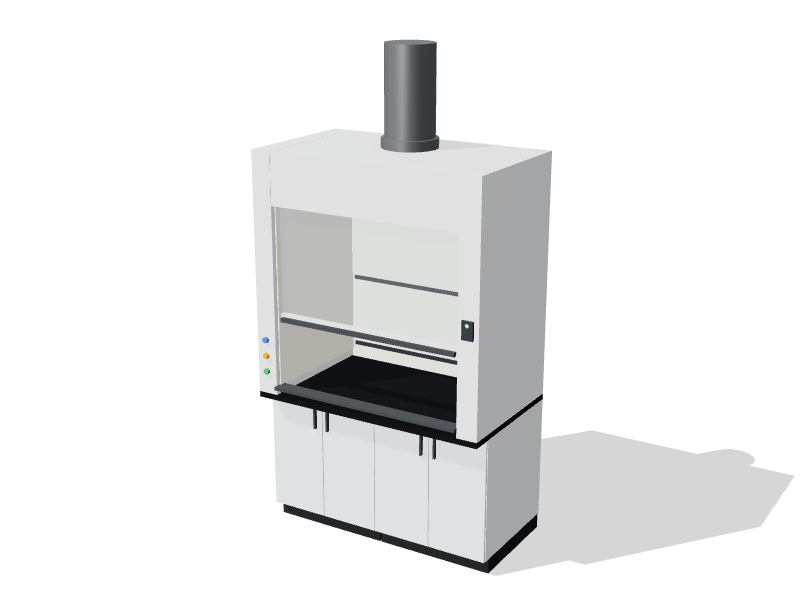
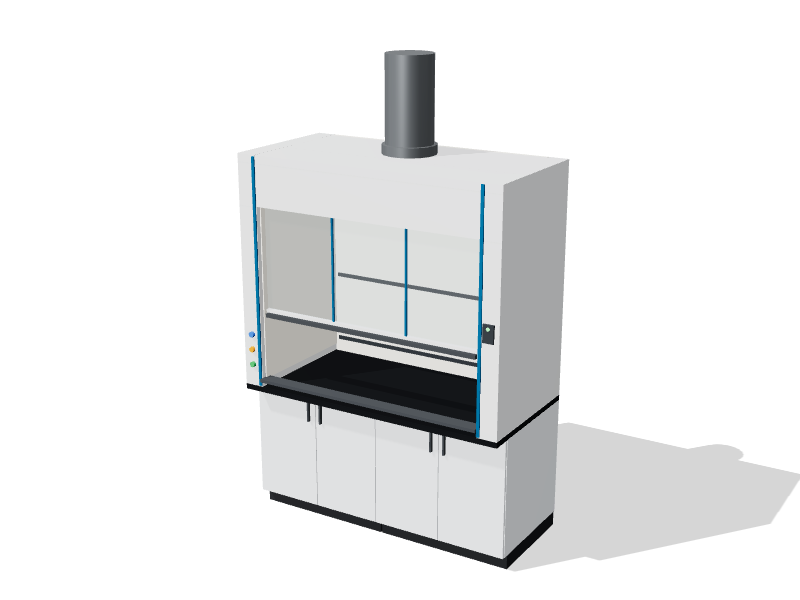
Every fume hood has to answer one question: what happens to the airflow when someone moves the sash? The answer defines the three main control strategies. It also shapes the building's mechanical design, the energy bill and what users need to understand about the hood in front of them.
Constant volume hoods
A constant air volume (CAV) hood exhausts the same amount of air whatever the sash position. The difference between the two CAV types is where that air comes in.
Conventional, without bypass
The simplest hood has only one way in: the face opening. As the sash closes, the same volume squeezes through a smaller opening, so face velocity rises in proportion. Lower the sash to a quarter of its design height and the face velocity roughly quadruples. Those high velocities cause turbulence at the sash edge, disturb light materials and balances, and make the hood noisy. Conventional non-bypass hoods are rarely specified for new labs.
Bypass
A bypass hood adds a second inlet, usually a bypass grille above the sash. As the sash comes down, it uncovers the bypass opening, and a growing share of the exhaust enters there instead of through the face. Face velocity stays within a reasonable range across the sash travel, and the hood keeps pulling its full volume through the chamber, which keeps the interior diluted even with the sash closed.
The cost is energy. A bypass hood draws the same exhaust, and the building supplies the same conditioned makeup air, whether the sash is open or shut, in use or idle. Through a Canadian winter, that is expensive air.
Bypass hoods remain a sound choice where:
- The building's exhaust system is constant volume and cannot be converted.
- The lab has only a few hoods, so the energy penalty is modest.
- The owner wants simple controls with little to maintain.
- Hoods run long processes with the sash open most of the time.
Bypass hoods are normally balanced to give the design face velocity at the sash stop height, commonly about 460 mm (18 in). The benchtop bypass hood in our catalog follows this pattern.
Variable air volume (VAV)
A VAV hood varies its exhaust flow to hold face velocity roughly constant as the sash moves. A sash position sensor or a sidewall velocity sensor signals a fast-acting valve or damper in the exhaust duct. Close the sash and the exhaust drops; open it and the valve opens to match.
VAV hoods usually keep a restricted bypass, just large enough to maintain a minimum exhaust flow with the sash closed. That minimum keeps the hood interior diluted and the duct under negative pressure. Your organization's design standard sets its value.
The room has to follow the hood. When hood exhaust falls, supply air to the room must fall too, or the lab loses its negative pressure relative to the corridor. A VAV hood is therefore part of a building system: hood controllers, supply and general exhaust valves, room pressure control and usually a link to the building automation system.
Related approaches:
- Two-state control: the hood switches between a high flow when in use and a low flow when the sash is closed or the lab is empty. Simpler than full VAV, with part of the savings.
- Automatic sash closers: lower the sash when nobody is at the hood, so VAV can drop to minimum.
- Occupancy setback: reduced flow or air change rates in empty labs, where the owner's standard allows.
Side-by-side comparison
| Feature | Conventional CAV | Bypass CAV | VAV |
|---|---|---|---|
| Exhaust volume | Constant | Constant | Varies with sash |
| Face velocity as sash closes | Rises sharply | Stays in a range | Held near set point |
| Energy use | High | High | Lower when sashes are closed |
| Controls to maintain | None | None | Sensors, valves, room controls |
| Typical fit | Rarely used now | Small labs, simple systems | Labs with many hoods |
What decides the savings
VAV only saves energy when sashes are closed. A VAV hood left wide open runs at full flow all day, exactly like a bypass hood. Savings depend on habits, so plan training, clear sash labels and alarms, and consider automatic closers where habits are hard to change.
VAV also needs care over its life. Sensors drift, valves stick and controllers need recalibration. Include VAV response in ASHRAE 110 testing at commissioning, and check controller and monitor calibration at each annual certification.
Pairing VAV with high-performance low-flow hoods does not simply add the two savings together. With sashes closed, a VAV system already runs at minimum flow, so the lower design flow of a high-performance hood only helps during the hours the sash is open.
Questions to ask
- Is the existing exhaust system constant volume, or can it modulate?
- How many hoods will the lab have, and how many are likely to be open at once? The answer sets the diversity factor used to size fans and air handlers.
- Who will maintain the controls, and do they have the skills and budget?
- What minimum flow does our standard require with the sash closed?
- How fast does the VAV controller respond to a sash opening, and has that been tested?
- How will users be encouraged to close sashes?
The mechanical engineer of record makes the final call on control strategy. For the wider picture, see fume hood energy use.