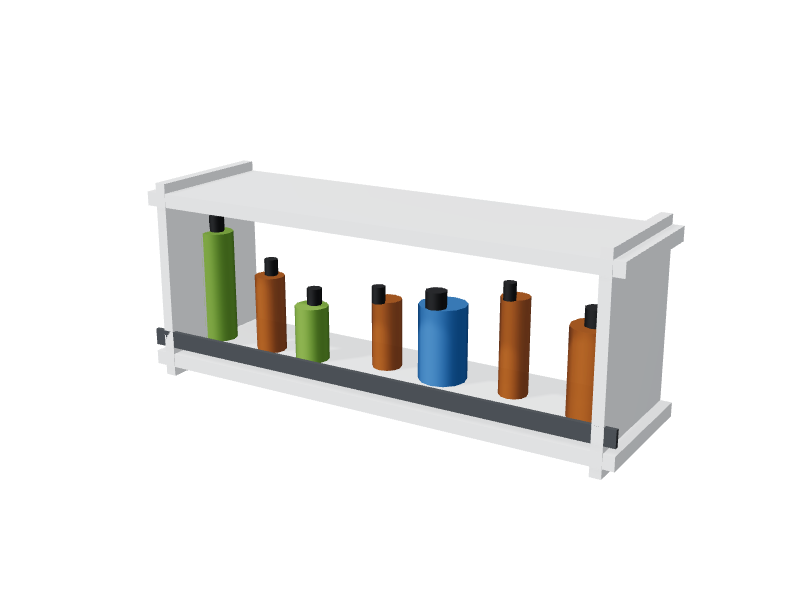
The 900 mm model
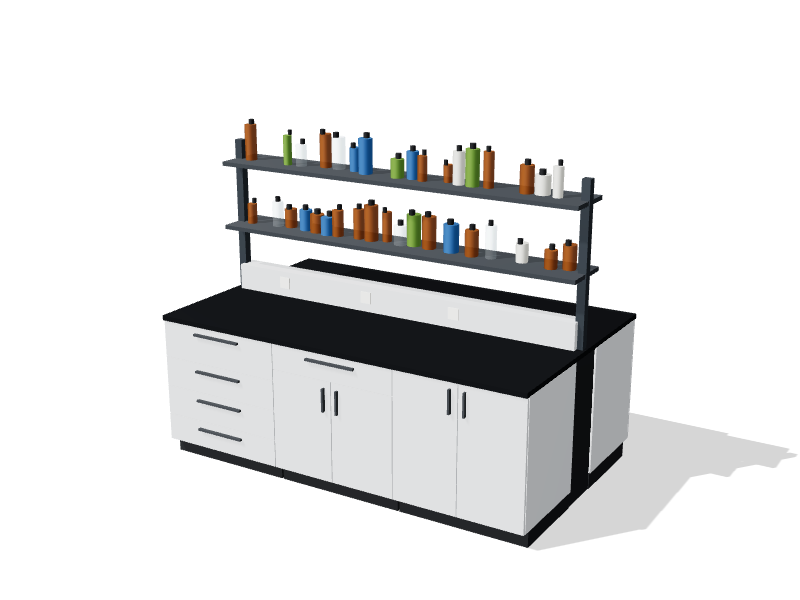
RS-OP-0900 is the 900 mm (35½ in) wide version of the open reagent shelf. It is 250 mm deep and 320 mm high, wall-mounted, 1,500 mm (59 in) above floor. It also comes in 1200 mm, 1800 mm.
Price by option at 900 mm
| Option | Choice | List price |
|---|---|---|
| Finish | Painted steel, Arctic white | $290 |
| Finish | Painted steel, Slate blue | $290 |
| Finish | Solid phenolic, Pearl grey | $320 |
| Finish | Maple veneer | $310 |
| Finish | Stainless steel 304 | $420 |
What it's for
An open reagent shelf keeps the bottles a person uses every day at eye level and within arm's reach, so they come off the worktop and the worktop stays free for work. It suits buffers, stains, indicators, wash bottles and small stock solutions. Think of it as working storage for the bench below, not as an extension of the chemical stockroom.
Construction and features
The shelf mounts to the wall and has a lip rail along the front edge so bottles do not walk off when the shelf is bumped or the building vibrates. Good-quality reagent shelves have a chemical-resistant finish, smooth edges, a rail high enough to stop small bottles yet low enough to lift a bottle over, and brackets that fix into the wall structure rather than relying on drywall anchors.
The open front is deliberate. Nothing has to be opened, which makes it more likely that people put bottles back where they belong. The trade-off is exposure: everything on the shelf collects dust and is on view, so containers must be capped, labelled and kept tidy.
Sizes and options
The finish options match the casework: painted steel, solid phenolic, maple veneer or stainless 304.
Where it fits
Open shelves are standard over perimeter benches in a histology and pathology lab, where stains and reagents are used in sequence, and in a high school science lab or food testing lab for indicators and routine solutions. Central benches usually carry their reagent shelving on the spine of an island bench instead.
Planning notes
- Store only small containers here. Large bottles, corrosives and anything that would cause serious harm if it fell belong lower down; see reagent shelving.
- Group bottles by compatibility, not alphabetically. Acids and bases, or oxidizers and organics, should not share a shelf.
- Keep the shelf away from direct sun, radiators and the space right above a hot plate.
- In seismic areas, check that the lip rail is tall enough for the bottles you plan to store, and ask your supplier about added restraint for tall containers.
- Do not mount a shelf directly above an instrument that a drip or a dropped bottle would damage.
All sizes
| Code | Width | Depth × height | From |
|---|---|---|---|
| RS-OP-0900 | 900 mm (35½ in) | 250 × 320 mm | $290 |
| RS-OP-1200 | 1,200 mm (47 in) | 250 × 320 mm | $340 |
| RS-OP-1800 | 1,800 mm (71 in) | 250 × 320 mm | $420 |